Universal Commerce Protocol (UCP) for WooCommerce

The Ultimate Guide on Universal Commerce Protocol (UCP) for WooCommerce

22 May

Introduction

Something fundamental shifted in e-commerce in January 2026, and most WooCommerce store owners have not yet caught up. When Google launched the Universal Commerce Protocol (UCP) in collaboration with Shopify, Walmart, Target, Etsy, Wayfair, Stripe, Visa, Mastercard, Flipkart, and over 20 other global partners, it did not just release another API standard. 

It marked the end of the “Destination Web” era, in which customers visited your store, and the beginning of Agentic Commerce, in which AI agents shop on their behalf. Your WooCommerce store can now receive purchase orders from Google Gemini, ChatGPT, Claude, and dozens of other AI assistants, with the customer never visiting your website at all. 

According to Statista’s AI in retail research, the global AI in e-commerce market reached $9.01 billion in 2025 and is projected to reach $74.93 billion by 2035, with a CAGR of 23.59%. In the USA specifically, the AI e-commerce market is valued at $2.46 billion in 2025 and is forecast to reach $20.92 billion by 2035. 

This blog acts as a Universal Commerce Protocol guide for beginners and tells you exactly what UCP is, how it connects to WooCommerce, what WooCommerce agentic commerce optimization means in practice, and how to implement it step by step.

What Is the Universal Commerce Protocol (UCP)?

Think of UCP the way you think of HTTP. HTTP is the universal language that lets any web browser talk to any website. UCP is the universal language that lets any AI shopping agent, Google Gemini, ChatGPT, Claude, Microsoft Copilot, discover products, manage carts, and complete purchases from any merchant’s backend, using a single standardized protocol.

Before UCP, every AI platform that wanted to offer shopping capabilities needed a custom, bespoke integration with every merchant, a bottleneck that was impossible to scale. 

UCP collapses that into a single WooCommerce AI agent integration point: build your UCP layer once, and every compatible AI agent surface can interact with your store without additional custom development. 

It standardizes the full commerce lifecycle product discovery, capability schema, cart management, checkout, order management, and post-purchase support through a shared, open-source specification built on REST and JSON-RPC, and fully compatible with MCP, Agent2Agent (A2A), and Agent Payments Protocol (AP2).

Critically, UCP does not replace your WooCommerce store. It sits alongside it. Your existing product pages, checkout flows, and CMS content are completely untouched. 

UCP just introduces a machine-readable, agent-accessible commerce layer that exists in parallel with your human-facing storefront. Your store continues to sell to human visitors the way it always has. It also now sells to AI agents 24/7.

Why WooCommerce Merchants Need UCP Right Now?

If your WooCommerce store is not UCP-compatible, it is becoming invisible to a fast-growing, high-intent segment of online shoppers. When someone asks Google Gemini to “find me an organic cotton t-shirt under $40 in size M and order it,” the agent does not browse your website. 

It interrogates UCP-compliant merchant backends for structured product data, size availability, material specifications, on-demand stock, return specifics, and shipping speed, and returns a recommendation that includes checkout options. If your store cannot respond to that query in machine-readable format, you simply do not appear in the results.

The Business Implications are Direct

Zero-Click eCommerce Transactions: Enable seamless purchases directly within AI platforms like Google AI Mode, Gemini, and ChatGPT — no website visit required.

Explosive AI-Driven Traffic Growth (4,700% YoY): Tap into a rapidly growing traffic channel accessible only to UCP-enabled eCommerce stores.

Google Business Agent Integration: Create a virtual storefront within Google Search, available exclusively for UCP-compliant merchants.

Agentic Commerce Optimization (ACO): Move beyond traditional SEO with ACO — the next-gen strategy for optimizing visibility across AI-powered shopping experiences.

First-Mover Competitive Advantage: Adopt UCP early to capture high-intent AI traffic and stay ahead of competitors in the evolving AI commerce landscape.

UCP vs. Traditional SEO: Understanding Agentic Commerce Optimization ACO

Agentic commerce optimization (ACO) is the UCP-era equivalent of SEO, and understanding the difference between the two is critical for WooCommerce store owners. 

Traditional SEO optimizes your store to rank in Google Search for human keyword queries: title tags, meta descriptions, backlinks, page speed, and content relevance. 

ACO optimizes your store to be selected by AI agents handling autonomous shopping mandates: data completeness, structured schema accuracy, real-time inventory reliability, return policy clarity, and response latency. The change is going from optimizing for human eyeballs to optimizing for machine retrieval qualification.

Factor

Traditional SEO

Agentic Commerce Optimization (ACO)

Optimizing 

Human keyword search

AI agent retrieval queries

Key Signals

Keywords, backlinks, page speed

Data completeness, schema accuracy, API latency

Discovery Surface

Google Search results page

Gemini, ChatGPT, Copilot AI agents

Transaction path

Click → visit store → checkout

AI agent completes checkout directly

Content Type

Marketing copy, blogs, landing pages

Structured product data, machine-readable feeds

Update Frequency

Periodic (weekly/monthly)

Real-time (live inventory & pricing)

Winner Criteria

Highest relevance + authority score

Most complete, accurate, and reliable data

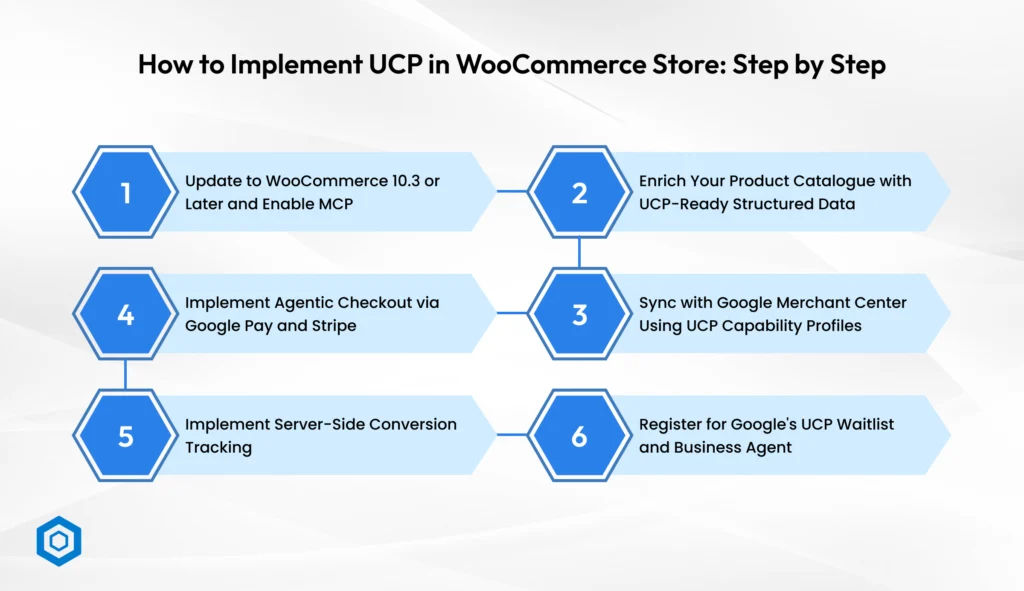
How to Implement UCP in WooCommerce Store: Step by Step

While implementing the Universal Commerce Protocol WooCommerce is a technical process, it does not mean you have to rebuild your store from scratch. Here is a way to tackle it step by step:

Implement UCP in WooCommerce

Step 1: Update to WooCommerce 10.3 or Later and Enable MCP

The first prerequisite is to make sure your store runs WooCommerce 10.3 or later, the version that integrated MCP (Model Context Protocol) natively. WooCommerce MCP is the base bridge layer that enables UCP-compatible AI agents to work with your store’s backend. 

After you’ve updated, you can turn on MCP in your WooCommerce settings and set agent permissions using WordPress’s Abilities API, defining exactly what agents are allowed to read/write/ transact in your store. 

The security configuration layer, getting this correct is also important: agents should have read access to product catalog and inventory data, and transactional access limited to UCP-authenticated checkout flows.

Step 2: Enrich Your Product Catalogue with UCP-Ready Structured Data

This is where most WooCommerce stores have the most work to do and where ACO begins. AI agents do not “read” your product descriptions the way humans do. They query structured data attributes to match products against user intent. 

Every product in your catalogue needs complete, accurate, machine-readable attributes: material composition, dimensions, compatibility, color variants, stock level by SKU, return window, shipping speeds by region, and answers to the most common product questions. 

By using JSON-LD schema markup on every product page, agents can reliably extract this data. If your catalogue is a feed of records designed for human browsing, think of this as a type of “semantic feed,” an AI version.

Step 3: Sync with Google Merchant Center Using UCP Capability Profiles

The implementation of UCP at Google takes place through Google Merchant Center. You have to sync your WooCommerce product feed with Merchant Center & UCP-specific attributes more than the Google Shopping feed, but also the comprehensive capability profile data that serves to cement and position your store as a “Trusted Agentic Provider” domain in Google AI Mode. 

This means that you’ll need to configure a UCP Capability Profile in Merchant Center announcing your store’s commerce capabilities (which include product discovery, agentic cart, checkout, order management, and post-purchase support). AI agent recommendations prioritize stores with complete capability profiles over stores with partial or no data.

Step 4: Implement Agentic Checkout via Google Pay and Stripe

Zero-click ecommerce transactions, in which the agent makes your product purchase within Google AI Mode or Gemini without your users actually visiting your site, now work only if you have connected Google Pay to WooCommerce checkout through the UCP payment layer. 

This uses the Agent Payments Protocol (AP2), which provides tokenized, cryptographically verified payment authorization, ensuring every transaction has proof of user consent and complete security compliance. 

Stripe’s Agentic Commerce Protocol (ACP), already integrated into WooCommerce, creates parallel rails for ChatGPT- and OpenAI-ecosystem transactions. With both AP2 and ACP implemented, your store is reachable across both the Google and OpenAI agentic commerce surfaces.

Step 5: Implement Server-Side Conversion Tracking

Because this is a purchase completed by an AI agent within Google Gemini, there’s no browser-based checkout flow, so standard Google Analytics and pixel-based tracking completely miss the conversion. 

Server-side conversion tracking records these transactions by sending purchase events directly from your WooCommerce server to Google’s Conversions via the API, bypassing the browser. 

This is essential for accurate measurement of your return on investment in newly augmented Google AI shopping WooCommerce visibility, and feeding the right conversion data back into Google’s optimization algorithms, thereby increasing your store’s ranking with future AI agent recommendations.

Step 6: Register for Google's UCP Waitlist and Business Agent

The UCP embedded checkout in AI Mode from Google is now being rolled out on a waitlist basis. Sign up for access to UCP in your Merchant Center account the sooner, the better; early adopters are getting preference placement in Google AI Mode and Gemini shopping results. 

Additionally, apply for Google’s Business Agent feature, which places an AI-powered store representative directly inside Google Search results for your brand, allowing shoppers to ask questions, check availability, and purchase without leaving the search interface. 

Merchants like Lowe’s, Reebok, and Poshmark are already live with Business Agent, and the program is actively expanding.

AI-Driven Revenue for WooCommerce Store

Conclusion

Universal Commerce Protocol is not a future upgrade; you can defer it is live infrastructure that is already routing AI-driven purchase traffic to UCP-compliant merchants right now. 

With global e-commerce sales heading toward $7.89 trillion by 2028, AI-driven retail traffic growing 4,700% year-on-year, and 93% of e-commerce businesses already recognizing AI agents as a competitive advantage, the window to build an early-mover position in agentic commerce is open, but it will not stay open indefinitely. 

Every WooCommerce merchant who implements UCP for ecommerce, enriches their product catalogue for machine retrieval, and connects their checkout to Google Pay via AP2 is positioning their store to capture a growing stream of zero-click AI transactions that currently have no competition. 

ACO agentic commerce optimization is the new SEO, and the merchants who master it first will own a channel that did not exist twelve months ago.

At Codeflash Infotech, we help WooCommerce merchants across India and the USA implement Universal Commerce Protocol WooCommerce MCP configuration, structured product data enrichment, and Google Merchant Center UCP capability profiles to agentic checkout integration with Google Pay and Stripe ACP, server-side conversion tracking, and full ACO strategy. 

If you want your WooCommerce store to be discoverable and transactable in Google AI Mode, Gemini, and ChatGPT, talk to our team today, and let’s make your store agent-ready before your competitors do.

Frequently Asked Questions

UCP is an open standard that allows AI agents like Google Gemini and ChatGPT to discover products and complete purchases from any merchant backend without the customer visiting your website. For WooCommerce merchants, it opens a direct sales channel within AI shopping surfaces, which is growing at 4,700% year-on-year.

The typical implementation (MCP setup + product data enrichment, Merchant Center capability profile, and agentic checkout) takes a minimum of 4-8 weeks for stores with clean data. 8–16 weeks are required in case of a store with an incomplete catalog or plugin conflicts.

SEO: Tailored to human searches, utilizing content, backlinks, and page authority. With data completeness and schema accuracy, ACO optimizes for API response speed and a real-time inventory because agents pick merchants by data quality, not content relevance.
Zero-click ecommerce transactions are the sales made by an AI agent in Google AIi Mode or Gemini without the shopper ever entering your store. Orders are placed via the Agent Payments Protocol (AP2) on Google Pay, and WooCommerce stores receive and process these orders directly in their own dashboard.