How to Build a Peer-to-Peer Marketplace App: Step-by-Step Guide
10 MARCH 2026
How people buy, sell, and trade services online has changed significantly as the sharing economy has grown. Peer-driven ecosystems are quickly becoming the backbone of digital commerce.
They include freelance platforms, resale markets, and places to stay and share rides. Because of this change, startups and businesses in the US have a huge need for peer-to-peer marketplace app creation.
Statista says that the global sharing economy will be worth more than $335 billion by 2025. Meanwhile, marketplace sites remain the most popular way for apps to make money worldwide.
Related Reading: Learn about How on Demand Service Apps Can Benefit Your Business
But making a marketplace work is a lot harder than just releasing a standard mobile app. Businesses must carefully plan platform architecture, user flows, trust mechanisms, and revenue models. This is why many founders actively research how to build a scalable, secure, and profitable peer-to-peer marketplace app.
This blog will walk you through the entire process, from the architecture and feature list for a peer-to-peer marketplace to ways to make money and the costs of development, so you can safely plan your next marketplace product.
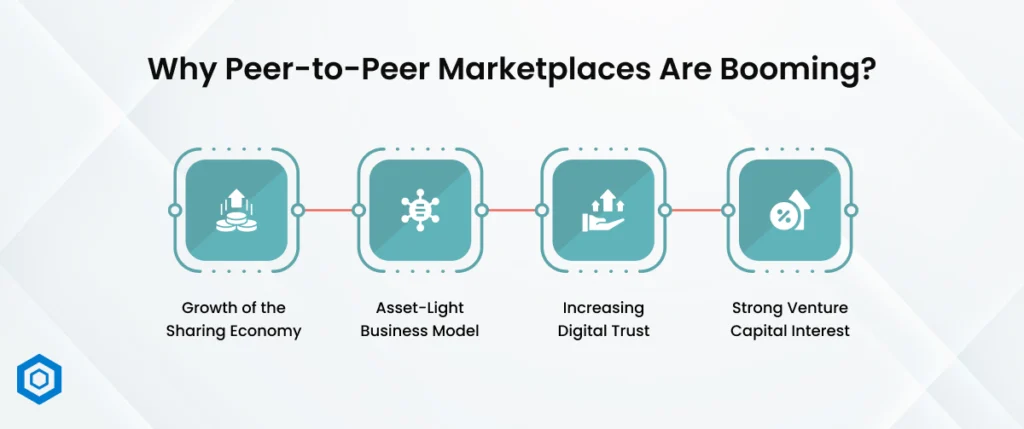
Why Peer-to-Peer Marketplaces Are Booming?
1. Growth of the Sharing Economy
It’s becoming easier for people to do business with one another rather than with traditional companies. Thanks to gig apps, hire services, and marketplaces for used products, people can now trade with each other anytime. That’s a big part of why people across the US are developing peer-to-peer trade apps.
2. Asset-Light Business Model
Most of the time, P2P sites don’t keep stock as regular e-commerce sites do. They stand between people who want to buy and people who want to sell. This method lets you make more money and grow faster because it requires fewer assets. This is why commission-based marketplace growth is a great choice for businesses.
3. Increasing Digital Trust
Market sites have much more user trust now that payments are safe and profiles, scores, and reviews are verified. It’s easier for buyers and sellers to work together these days because there are better ways to build trust. People now think that these qualities are important for any real plan to create a P2P marketplace.
4. Strong Venture Capital Interest
Investors keep putting money into marketplace startups because they can make substantial returns over time. Once there is enough capital, markets can grow quickly with low marginal costs. This is why many founders are exploring how to build a peer-to-peer marketplace app in high-demand niches.
How to Build a Marketplace App?
It takes more thought to build a marketplace than to build a normal mobile app. Here are some general steps every P2P marketplace app development company should take when planning to build a trade app.
Step 1: Identify Your Niche & Liquidity Strategy
The chicken-and-egg problem between buyers and sellers is crucial to a marketplace’s success. Find a focused niche where you can build early cash as your first step. Peer-to-peer marketplace app development is much more likely to succeed if the niche is clear.
Step 2: Define Your Value Proposition
Make it very clear why people should use your tool instead of others already available. Whether it is lower fees, better trust mechanisms, or specialised inventory, your differentiation must be obvious. When building a competitive P2P marketplace, it’s important to take a strong stance.
Step 3: Plan Trust & Safety Mechanisms
Trust is what holds a market together. You should start planning early to verify your name, scores, reviews, and safe payment methods. At the moment, these are the most important parts of a peer-to-peer community.
Step 4: Choose the Right Development Approach
Choose whether to start with an MVP or a full platform. Many great founders start small and grow based on customer feedback.
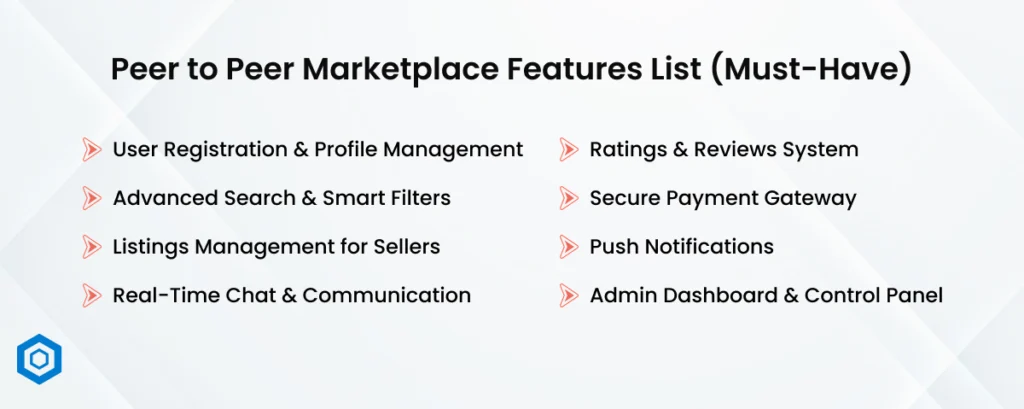
Peer to Peer Marketplace Features List (Must-Have)
When building a peer-to-peer marketplace app, the features directly affect how many people use it, how much trust they have in it, and how much money it can generate. There should be a good mix of tools for sellers, tools for buyers, and admin control on a good platform. These are the most important things that every scalable peer-to-peer marketplace app development project should have.
- User Registration & Profile Management
It’s important for both buyers and sellers that the hiring process goes smoothly. The app should let users make full profile changes and sign up via phone, email, or social login. If you really want to build a P2P marketplace, you need robust profile systems people can trust.
- Advanced Search & Smart Filters
Users of the marketplace expect to be able to quickly and easily find what they’re looking for. The location, price, category, ratings, and availability options in advanced search make it easy for users to quickly find what they need. If you want to know how to make a marketplace app, this feature is considered important because it gets people much more interested.
- Listings Management for Sellers
Adding pictures, prices, and details to an ad should be easy for sellers. They should also be able to check whether the item is still available and update their ads as needed. Once the selling process is done well, there is more supply, which is good for market liquidity. Being able to do this is one of the most important parts of making a peer-to-peer trade app.
- Real-Time Chat & Communication
Direct messaging between buyers and sellers speeds up deals and reduces problems. People can also trust real-time chat because it lets them ask questions before they make a purchase. Most successful platforms make messaging an important part of their peer-to-peer trading features.
- Ratings & Reviews System
Mechanisms of trust hold a market together. A clear way to review and rate sellers helps users decide who to buy from and makes the site more trustworthy. When building a fee-based marketplace, it’s especially important to have strong reputation systems.
- Secure Payment Gateway
Payment processing is built right into the app, so deals are quick and safe. Users feel safer when they can use tools like trust payments, get their money back, or split payments. One of the most important parts of building a P2P trade site is setting up payment methods.
- Push Notifications
To keep users excited, messages, order updates, price changes, and sales should be sent to them at the right time. Smart ways to send reminders make it much easier to remember them. That’s why this feature is important for creating peer-to-peer trade apps that more people can use.
- Admin Dashboard & Control Panel
As the platform owner, you can manage users, monitor transactions, resolve disputes, and get insights into how the platform is performing from the admin panel. This central control layer must be part of the plans of any professional P2P marketplace app development company developing P2P trading apps.
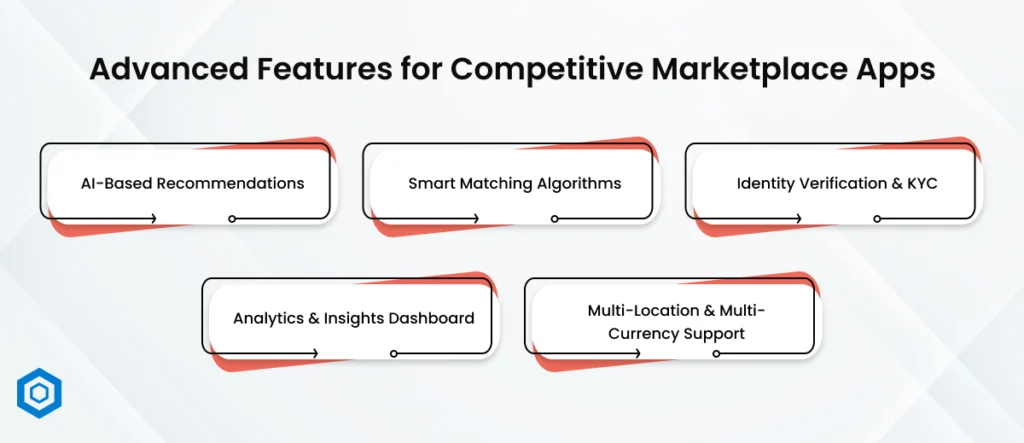
Advanced Features for Competitive Marketplace Apps
If a business wants to stand out in the US market, it might want to add more advanced features beyond the basicpeer-to-peer marketplace app development features already on the list.
- AI-Based Recommendations
If you watch how people use a computer, you can figure out what they might like and offer it to them. People are more interested and engaged, and more deals happen, when they can find things personalised to them. When new companies try to build a peer-to-peer trade app, they focus on making it as AI-powered as possible.
- Smart Matching Algorithms
When service platforms smartly match buyers and providers, they make more sales. Location, availability, reviews, and past behaviour can all be taken into account when matching. This function is very useful for building advanced commission-based marketplaces.
- Identity Verification & KYC
Better identification reduces fraud and helps users trust each other. Many US markets now require proof of identity, a real phone number, or documents. A professional peer-to-peer marketplace app creation sets itself apart by prioritising security across all its designs.
- Analytics & Insights Dashboard
Providing sellers with performance metrics such as views, conversions, and earnings improves platform stickiness. Insights based on data push people to be more involved. This feature helps the development of P2P marketplace platforms grow in the long run.
- Multi-Location & Multi-Currency Support
Supporting various currencies, regions, and tax systems is necessary if you want to go global. This feature makes your site future-ready. Many businesses planning how to monetize a marketplace app include this early in their roadmap.
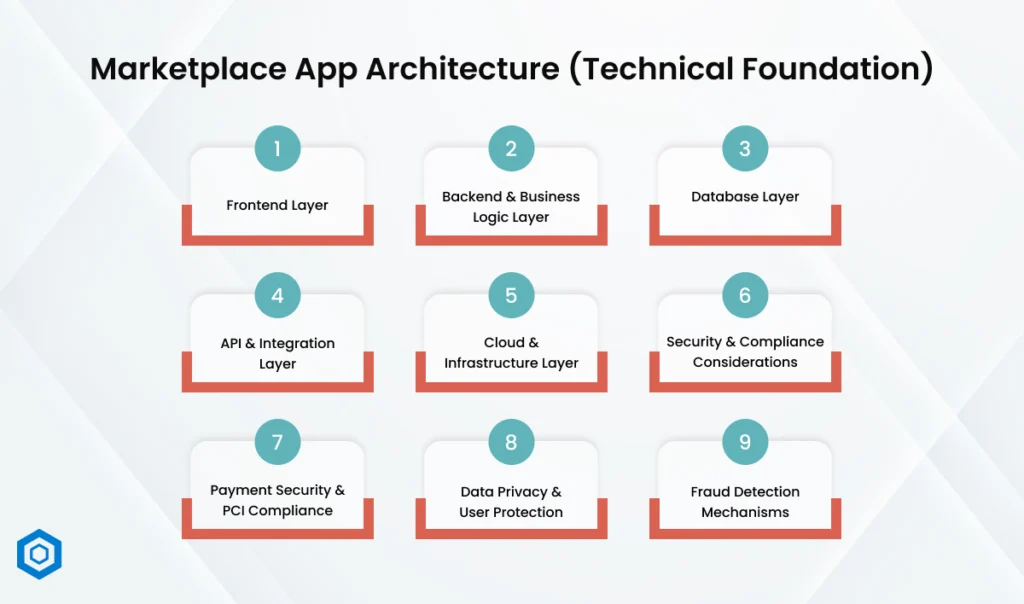
Marketplace App Architecture (Technical Foundation)
A strong architecture is what separates scalable marketplaces from apps that fail under growth pressure. Choosing the right technical architecture is crucial when planning a marketplace app.
- Frontend Layer
The frontend handles browsing, messaging, transactions, and user interactions. It is easier to make experiences that work on many devices with frameworks like Flutter and React Native. If you want to make a peer-to-peer trading app, the front end needs to work well.
- Backend & Business Logic Layer
The backend is responsible for user verification, process tracking, payment acceptance, and matching algorithms. Many people use languages like Java, Node.js, and Python. For a P2P trading tool to be scalable, it needs a strong backend.
- Database Layer
Market apps need to quickly and easily handle user, listing, transaction, and review data. You can use databases like MySQL, PostgreSQL, and MongoDB a lot. A well-designed library will always work well at a large scale.
- API & Integration Layer
This layer links external services, such as payment methods, security systems, and identity verification tools. Because the API is clean, it’s easy to add new features after the fact. You need strong links to build a marketplace that pays people to buy and sell.
- Cloud & Infrastructure Layer
Like AWS, Google Cloud, or Azure, the cloud keeps your info safe, lets you grow, and is always online. Thanks to technology that can grow on its own, your market will be able to handle big jumps in growth. If you want to make a peer-to-peer trade app for the US market, you need to know this.
- Security & Compliance Considerations
Websites that sell products need robust security, especially those that handle financial information and personal data.
- Payment Security & PCI Compliance
With secure payment handling that meets PCI-DSS standards, users’ financial information is kept safe. When an exchange system is in place, buyers and sellers can trust each other even more. This needs to be done by skilled app developers for peer-to-peer markets.
- Data Privacy & User Protection
It is against the law in the US to violate privacy rules or to lose user information. Encryption, safe identification, and role-based access control are all important. Building a P2P trading platform over the long term works best on systems that are ready for compliance.
- Fraud Detection Mechanisms
Robots that look for scams can find deals that don’t seem right and fake accounts. More and more, machine learning models are being used to lower platform risk. This capability is especially important in commission-based marketplace development environments.
How to Monetize a Marketplace App?
Picking the right way to make money is very important when building a peer-to-peer marketplace app. A well-thought-out monetisation plan keeps the site appealing to both buyers and sellers and ensures long-term growth. For building a robust P2P marketplace platform, here are the models most often used.
1. Commission-Based Model
Charging a percentage of each successful trade is the most common way to build a commission-based marketplace. This plan links platform income to user activity, making it very easy to expand. Many founders like this approach to learning how to make money with a marketplace app because it provides steady, ongoing income.
2. Featured Listings & Promotions
The owners of a marketplace can charge sellers to have their items appear higher in search results, on sponsored ads, or on the home page. This adds another way to make money without making transactions more difficult.
When it comes to creating peer-to-peer marketplace apps, featured placements work especially well in highly competitive niches.
3. Subscription Plans
Some platforms charge service providers or buyers a monthly or annual fee for access to additional tools or more listings. Subscription plans give you a steady stream of income, and you can often add profits to them. Plans to build a P2P marketplace platform that are more complicated often use this mixed way.
4. Payment Processing Fees
Platforms can make small amounts of money by handling payments or serving as trust agents. The number can bring in a lot of money over time, even though it’s not as high as fees. This model is often part of communities that develop commission-based markets.
5. Value-Added Services
Advanced marketplaces monetise through analytics tools, insurance offerings, verification badges, or logistics support. These paid add-ons make the site more valuable and give you more ways to make money. People often add these features as their businesses grow, and they learn more about building a peer-to-peer trade app.
Why Choose Codeflash Infotech for Marketplace Development?
US businesses looking to invest in peer-to-peer marketplace app development can trust Codeflash Infotech to meet their technology needs. The team helps companies and new businesses launch powerful, scalable marketplaces that align with their business goals. We specialize in peer-to-peer marketplace app development solutions that are built to grow and designed to deliver an exceptional user experience.
For example, we can help with product planning and UI/UX design, as well as development, testing, and making the app better after it’s released. Because of this, we are a trusted partner for companies looking to build marketplaces that will work in the future.
Conclusion
US businesses looking to develop peer-to-peer trading apps need a technology partner that understands both the product and the market. Codeflash Infotech has been building scalable marketplace platforms for startups and established businesses for years, with end-to-end expertise spanning:
- Product strategy & market research — niche analysis, competitor benchmarking, liquidity planning
- UI/UX design — user-tested, conversion-optimised interfaces for buyers and sellers
- Full-stack development — React Native / Flutter frontends, Node.js / Python backends, cloud infrastructure
- QA & security testing — PCI-compliant payment flows, fraud detection, and penetration testing
- Post-launch optimisation — analytics, A/B testing, and iterative feature development
See our portfolio to explore real-world marketplace apps we have delivered.
Putting out an app isn’t enough, though, if you want to be great at making a PoS platform. Businesses need to plan how to set up a peer-to-peer marketplace, which features to include, and how to generate long-term revenue.
Codeflash Infotech has been building P2P marketplace apps for years and will ensure your marketplace is scalable and ready to generate long-term revenue.
Frequently Asked Questions
Your peer-to-peer marketplace app should work in your area before you start making it. You should also build an MVP and plan how buyers and sellers will communicate. You are much more likely to be successful if you work with a P2P marketplace app development company that has been around for a while.
A peer-to-peer market needs a manager dashboard, advanced search, user profiles, secure payments, control over postings, real-time chat, ratings and reviews, and secure payments. Smarter systems might also use AI to make tips and check people’s identities.

Many people make money through subscription plans, commission fees, paid ads, payment-handling margins, and value-added services. It is very important to choose the right model when monetising a shopping app.
Most of the time, building a simple marketplace MVP takes 3 to 5 months. However, making a full-featured platform could take 9-10 months or more. The time difference depends on how hard it is, how many integrations there are, and how skilled your programming partner is.