
 Avadh Ladani
Selecting the right frontend technology is one of the most important decisions when building a web application. The framework or library you choose can impact development speed, application performance, SEO visibility, user experience, and long-term scalability.
Among modern JavaScript technologies, Next.js vs React is one of the most common comparisons for startups, businesses, and development teams. While React is a powerful library for building user interfaces, Next.js extends React with built-in capabilities such as server-side rendering, routing, and performance optimization.
So, which one is right for your project?
The answer depends on your business goals, application requirements, and growth plans. Whether you’re building a SaaS platform, business website, eCommerce store, or startup MVP, understanding the differences between Next.js and React can help you make a more informed technology decision.
Let’s explore how these technologies compare and which option best aligns with your project requirements.
Next.js is a React framework developed by Vercel that provides a complete foundation for building modern web applications.
While React focuses primarily on building user interfaces, Next.js adds a variety of production-ready features such as server-side rendering, static site generation, routing, image optimization, and performance enhancements.
These built-in capabilities reduce development complexity and help teams create scalable, SEO-friendly applications more efficiently.
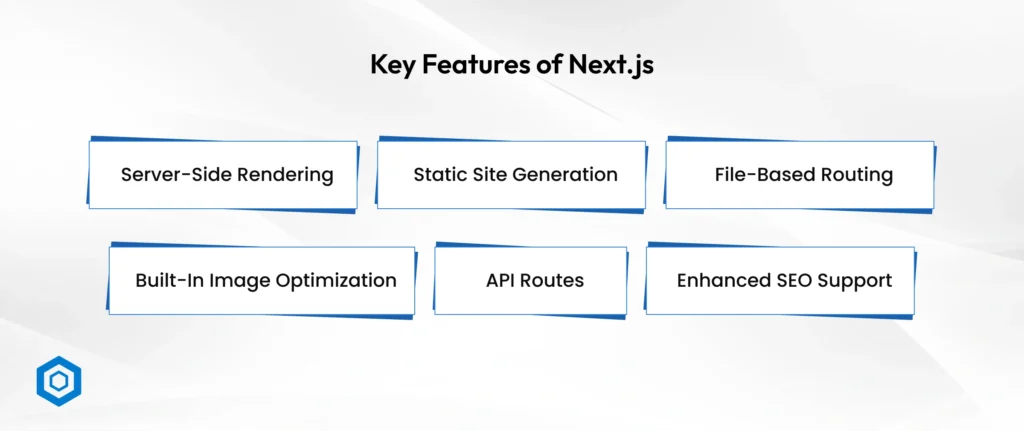
Server-Side Rendering (SSR): Next.js can render pages on the server before sending them to users. This improves page load speed and allows search engines to access fully rendered content immediately.
Static Site Generation (SSG): Pages can be generated during the build process and served instantly to users, improving performance and reducing server load.
File-Based Routing: Developers can create routes simply by adding files within the application structure. This eliminates the need for complex routing configurations.
Built-In Image Optimization: Next.js automatically optimizes images for different devices and screen sizes, helping improve Core Web Vitals and user experience.
API Routes: Developers can create backend endpoints directly within the application without setting up a separate backend service for basic functionality.
Enhanced SEO Support: Server rendering and pre-rendering make Next.js highly effective for websites that depend on organic search traffic.
Businesses choose Next.js because it offers:
As businesses increasingly prioritize search visibility, performance, and user experience, many choose to Hire Nextjs Developers who can build scalable, SEO-friendly applications using modern rendering and optimization techniques.
React is an open-source JavaScript library developed by Meta for building user interfaces.
Since its launch, React has become one of the most widely adopted frontend technologies due to its flexibility, component-based architecture, and strong developer ecosystem.
React allows developers to build interactive interfaces by creating reusable UI components that can be efficiently updated whenever application data changes.
Unlike Next.js, React focuses specifically on the view layer of an application. Additional functionality such as routing, server-side rendering, state management, and SEO optimization often requires third-party libraries and custom configuration.

Component-Based Architecture: Applications are built using reusable components, making development faster and maintenance easier.
Virtual DOM: React updates only the parts of the interface that change, improving rendering performance.
Large Ecosystem: Developers can access thousands of libraries and tools to extend application functionality.
Flexible Architecture: React does not enforce strict project structures, allowing teams to build applications according to their preferences.
Strong Community Support: React has one of the largest developer communities, resulting in extensive documentation, tutorials, and third-party integrations.
React remains popular because it offers:
As React applications grow in complexity, many businesses prefer to Hire React Developers who can build scalable architectures, maintain code quality, and deliver faster development cycles.
Before comparing features, it’s important to understand that React and Next.js are closely related.
Understanding this relationship makes it easier to choose the right technology based on your project’s requirements rather than viewing them as competing solutions.
Compare Next.js and React across performance, SEO, rendering, routing, and scalability to choose the right development framework.
| Feature | Next.js | React |
|---|---|---|
| Technology Type | React Framework | JavaScript UI Library |
| Rendering | Server-side, Static & Client-side | Client-side (default) |
| SEO | Excellent | Limited by default |
| Performance | Built-in optimizations | Requires manual optimization |
| Routing | File-based routing | External library required |
| Static Site Generation (SSG) | Built-in | Requires additional tools |
| Server-Side Rendering (SSR) | Built-in | Requires configuration |
| API Routes | Built-in | Separate backend required |
| Image Optimization | Built-in | External solution required |
| Initial Setup | Faster for production projects | More configuration required |
| Scalability | Excellent | Excellent |
| Learning Curve | Moderate | Easier |
| Best For | SEO-driven websites, SaaS, eCommerce | Dashboards, SPAs, Internal tools |
While both technologies are powerful, Next.js includes built-in features that simplify development, while React often requires additional libraries and configuration to achieve similar functionality.
Application performance directly impacts user experience, search rankings, and conversion rates.
A slow-loading website can increase bounce rates and reduce customer engagement, making performance a critical consideration when choosing between Next.js and React.
Next.js includes several performance optimizations by default.
These include:
Because many optimizations are built into the framework, development teams can achieve better performance with less manual effort.
For content-driven websites, SaaS platforms, and customer-facing applications, Next.js often delivers faster initial page loads and stronger Core Web Vitals scores.
React applications typically render content in the browser through client-side rendering.
This approach works exceptionally well for highly interactive applications but may increase the time required to display content during the initial page load.
To improve performance, developers often implement:
While React can achieve excellent performance, these optimizations usually require additional configuration and development effort.
Search engine optimization is often the deciding factor when choosing between Next.js and React.
If your business relies on organic traffic, content marketing, product discovery, or lead generation through search engines, understanding how each technology handles SEO is essential.
Next.js was designed to address many of the SEO limitations associated with client-side rendering.
Using server-side rendering and static site generation, Next.js delivers fully rendered HTML content to search engines immediately.
This approach offers several advantages:
For businesses investing in SEO, content marketing, or inbound lead generation, Next.js generally provides a stronger foundation.
Traditional React applications primarily use client-side rendering. When a user visits a page, the browser downloads JavaScript files and then generates the page content.
Although modern search engines have improved their ability to process JavaScript, client-side rendering can still create challenges such as:
React websites can absolutely rank well in search results, but achieving strong SEO often requires additional implementation and optimization efforts.
SEO Winner: Next.js – If organic traffic is important to your business strategy, Next.js is usually the preferred choice.
A technology decision should support not only current requirements but also future growth.
Scalability involves handling increased traffic, expanding features, supporting larger teams, and maintaining application performance over time.
Next.js provides several built-in capabilities that support long-term scalability.
These include:
These features help organizations scale applications without introducing unnecessary complexity.
React is highly scalable when implemented using proper architecture patterns.
Large organizations use React successfully for:
However, as applications grow, teams often need to manage multiple external libraries and custom configurations.
Scalability Winner: Next.js For customer-facing applications expected to grow significantly, Next.js often provides a more streamlined path to scale.
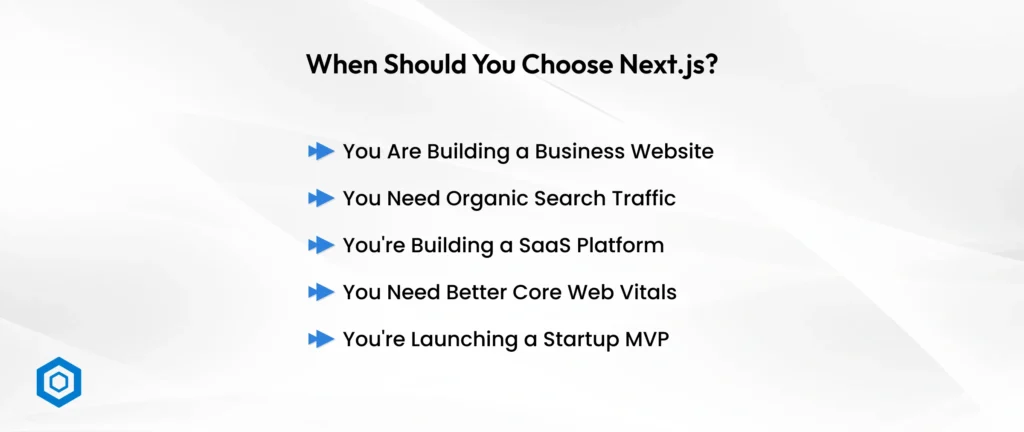
You Are Building a Business Website
Corporate websites, service-based businesses, and company websites benefit from better SEO and faster page loads.
You Need Organic Search Traffic
Content-driven websites and marketing-focused businesses often see better results with server-rendered pages.
You’re Building a SaaS Platform
Many modern SaaS products use Next.js because it balances performance, scalability, and developer productivity.
You Need Better Core Web Vitals
Google continues to prioritize user experience metrics, making performance optimization increasingly important.
You’re Launching a Startup MVP
Startups often need faster development, strong SEO, and the ability to scale quickly as user adoption grows.
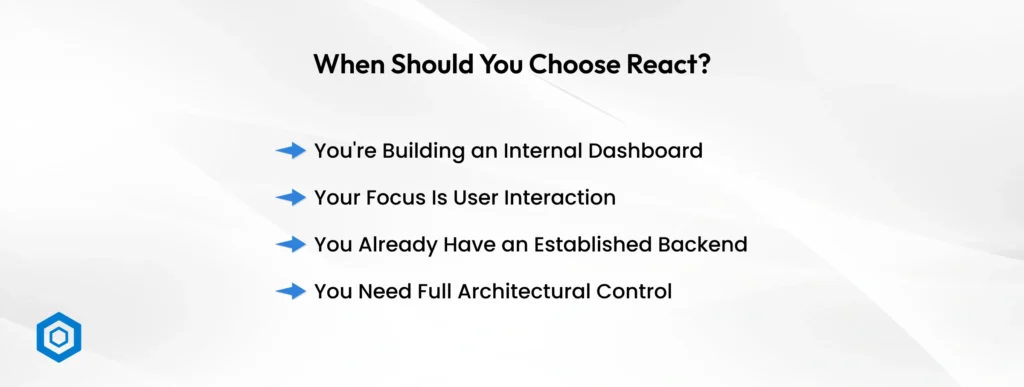
You’re Building an Internal Dashboard
Applications used exclusively by employees generally don’t require SEO optimization.
Your Focus Is User Interaction
Highly dynamic interfaces often benefit from React’s flexibility.
You Already Have an Established Backend
If a backend infrastructure already exists, React can integrate seamlessly.
You Need Full Architectural Control
Development teams with unique requirements may prefer React’s flexibility over framework conventions.
For businesses building complex frontend applications, partnering with an experienced React Development Company can help streamline development, improve maintainability, and deliver exceptional user experiences at scale.
Requirement | Recommended Choice |
SEO & organic traffic | Next.js |
Fast page loads | Next.js |
Business websites | Next.js |
SaaS applications | Next.js |
Startup MVPs | Next.js |
eCommerce stores | Next.js |
Better Core Web Vitals | Next.js |
Internal dashboards | React |
Admin panels | React |
Data visualization tools | React |
Interactive applications | React |
Maximum flexibility | React |
Expert Tip: If your application relies on organic traffic, content marketing, or lead generation, Next.js is often the preferred choice. For internal tools, dashboards, and highly interactive user experiences, React remains an excellent option.

Choosing between Next.js and React depends on your business goals and application requirements. React is an excellent choice for highly interactive applications and internal tools, while Next.js offers advantages in SEO, performance, and scalability for customer-facing products.
For most modern websites, SaaS platforms, and digital products, Next.js provides a more complete development framework. As a trusted Web Application Development Company, Codeflash Infotech helps businesses select the right technology stack and build scalable, high-performance web applications tailored to their growth objectives.
No, Next.js is built on React. Choosing Next.js means you’re still using React but with additional capabilities and framework features.
React generally has a simpler learning curve initially. However, Next.js often simplifies real-world application development because many common requirements are already included.
Yes. Next.js provides server-side rendering and static generation features that make content easier for search engines to crawl and index.
Absolutely, many organizations use Next.js for scalable customer-facing applications, SaaS platforms, and enterprise websites.
Yes, React remains one of the most widely adopted frontend technologies and continues to power countless web applications worldwide.
For most startups building public-facing products, Next.js offers advantages in SEO, performance, and development speed.