MVP Development for Startups: A Step-by-Step Guide
13 JANUARY 2026
The single-biggest reason most entrepreneurs fail in business (it’s Not What You Think). Most startups don’t fail because they can’t build and deliver a product.
According to Statista, a report on startup failure rates states that a high percentage of startups fail because they do not align their product with the market they intend to serve, making MVP development for startups an indispensable approach to validation and risk mitigation in their early phase.
As the global IT outsourcing industry is expected to reach $591.24 billion in 2025, many companies are hiring professional MVP development partners to accelerate time-to-market and manage technological complexity.
Founders no longer incur heavy upfront investment early on; instead, they start with minimum viable product development to test their ideas quickly and get honest user feedback.
In this blog, we will discuss how to develop an MVP and the cost of building one. What exactly is an MVP? How to Build It? A simple step-by-step lesson for successful startup MVP development.
What MVP Development?
In the startup world, MVP development means you create a core product that gets straight to the core of what it’s supposed to do. The objective isn’t perfection but rather learning, getting small tidbits of confirmation in a cost- and time-effective manner.
For start-ups, too, it’s about enabling more rapid experimentation and iteration. It allows founders to learn whether users actually need the solution before they scale it into a fully featured product.
The Real Purpose of MVP Development for Startups
The primary purpose of MVP development is validation, not revenue or scale. Startups use MVPs to test hypotheses, understand user behaviour, and refine product direction based on real-world data.
- Validate the Core Problem-Solution Fit
- It helps you identify whether the problem you’re solving actually exists and whether users even care enough about your solution. This first validation reduces the risk of developing features that no one uses.
- Learn From Real Users, Not Assumptions
- Startups get actual feedback from early adopters instead of making assumptions. This feedback mechanism enables smarter choices at every step of the startup’s MVP development process.
- Create a Clear Product Roadmap
- MVP usage-based insights also help founders prioritise features for the next release. This way, they can ensure their development efforts focus on what users need.
MVP vs Prototype vs Full Product: What Startups Must Understand
Startups often misunderstand the differences among prototypes, MVPs, and full products. There’s a difference for a reason. Knowing this contrast is essential when you are creating an MVP app.
A prototype is a tool for visualising ideas, and an MVP is an operational product that operates in the real world. All of the full products come later, once something has been validated, and scaling is what’s on the menu.
Right Time to Build a Minimum Viable Product
A sense of timing is key to an MVP. Building an MVP too late can waste resources, while building it too early without clarity can lead to poor results.
1. When the Market Need Is Uncertain
Timing is key to the success of MVPs. Creating an MVP too late can result in wasted resources, while making one too early, pickled & without understanding, can yield lacklustre results.
2. When Speed Matters More Than Features
Startups that enter markets in which they have to compete do better than those that launch quickly. An MVP is a faster entry without a fully developed product.
3. When Funding and Resources Are Limited
The MVP development cost for startups is lower than the full development cost, making it suitable for early-stage companies.
Key Roles Involved in Startup MVP Development
Creating a successful MVP requires collaboration among business, technology, and user roles. The direction of the product is everybody’s responsibility.
1. Founders and Product Strategists
They would then define the vision, success measures, and priorities for the MVP. But their desire to focus on the problem at hand leads them to believe that there is little chance of product killing.
2. Design and Development Teams
These are the teams that can take a napkin sketch and turn it into something that works, leveraging their craft and imagination to maximise velocity, usability, and technical feasibility.
3. Early Users and Market Testers
The enthusiast calls feedback from their actions. This feedback shapes the following versions of their product.
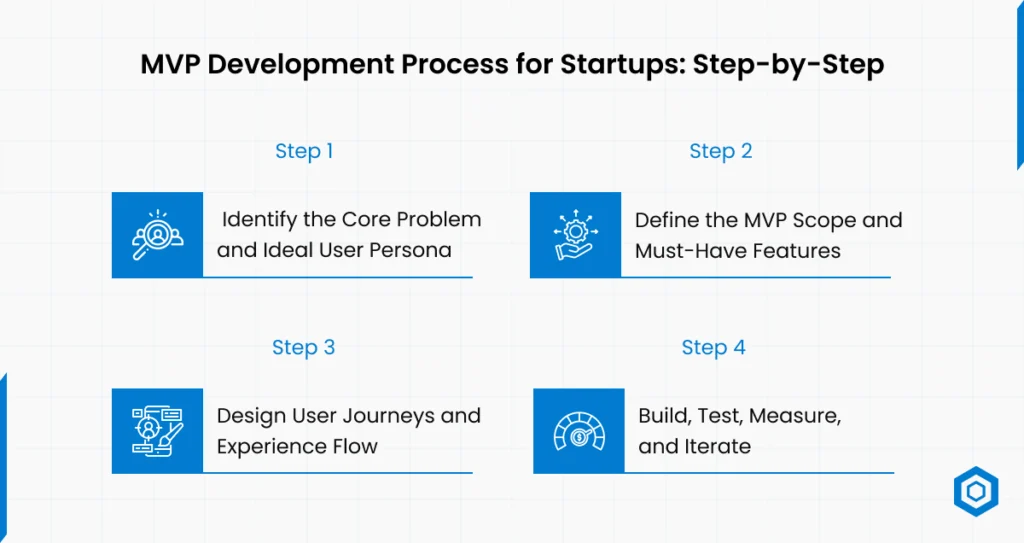
MVP Development Process for Startups: Step-by-Step
An MVP development process enables startups to test ideas rapidly and at minimal cost.
Step 1: Identify the Core Problem and Ideal User Persona
It begins with a well-defined understanding of the problem your startup is really solving (and for whom). When you know the pain points of the users, MVP won’t be about assumptions, but actual demand, and that is one secret to how a startup launches its MVP successfully, step by step.
Step 2: Define the MVP Scope and Must-Have Features
Startups also need to pare down the product features that demonstrate value. As a result, the product isn’t overbuilt and stays lean; both factors decrease price for MVP development of a startup and accelerate time-to-market
Step 3: Design User Journeys and Experience Flow
A clear user path guides users from the welcome page to the core action. Revolutionary UX design boosts usability, speeds initial adoption, and enables the product’s audience to find its value as soon as possible during MVP development.
Step 4: Build, Test, Measure, and Iterate
We then build an MVP agilely through a series of experiments. Improvements are driven by user feedback and in-the-wild usage, so the product iterates on data rather than guesses.
Core Features That Every Startup MVP Should Include
For the MVP, most focus on deciding which features will demonstrate the idea without making it overly complex. Every feature should be validating, learning, and engaging for the user.
1. Simple User Onboarding and Authentication
A great onboarding process enables users to start using the MVP quickly without friction. The easier it is to sign in, the more users sign up and take a step closer toward engagement with the core functionality.
2. Primary Value-Driving Functionality
Our feature directly solves the user’s primary problem. There, the MVP has to show this benefit loud and clear to determine whether people are ready to adopt and keep using the product.
3. Basic Analytics and Usage Tracking
Analytic tools track what users are doing, which features are used most, and how many drop off. Such observations can be valuable as startups develop a sense of which products work, which don’t, and how they might improve over time.
4. User Feedback and Reporting
There are feedback features that allow users to share their opinions, report issues, and recommend changes. This feedback is valuable for building out the product roadmap and achieving better results in minimum viable product development.
How to Build an MVP for a Startup?
Attempting to do too much too early is one of the biggest mistakes startups make. This way, applying lean methods to your validation no longer becomes just a best practice; it can make or save you money by getting there faster.
1. Focus on Outcomes, Not Features
Startups should focus on the result the user wants, not on adding multiple features. This keeps development aligned with the core problem.
2. Avoid Perfection in the First Release
MVPs are not to impress; they’re to test. The acceptance of imperfection means faster launches and faster learning, which is very important in the world of building an MVP for a startup.
3. Prioritise Speed Over Scalability Initially
MVPs are about speed and flexibility, not about rocking for scale. Once validation had occurred, the product could be optimised for growth.
Technology Stack Selection for MVP App Development
The right tech stack enables accelerated development and an MVP that scales easily in the future. Startups need to weigh speed, cost, and flexibility.
1. Frontend Technologies for Rapid UI Development
Such as React, Flutter, or Vue.js, and get fast interface updates with feedback. In fact, the startups can polish their UX without an extensive redevelopment by leveraging these technologies.
2. Backend Technologies for Flexible Architecture
Light backend frameworks, such as Node.js in JavaScript or Python, enable rapid, easy modification and development. This agility is critical during the early stages of developing an MVP app.
3. Cloud Infrastructure for Cost Control
Start-ups can tailor cloud services to their needs and be billed only for what they use. This allows for cost control of the underlying infrastructure, handles temporary traffic spikes, and scales easily for future growth.
4. Third-Party APIs to Accelerate Development
APIs for authentication, payments, or notifications similarly speed up development. This approach allows you to MVP faster while delivering the meaty aspects of the product.
How MVP Development Helps Reduce Startup Risk
MVP development mitigates financial and market risks by testing the idea before investing significant resources. Startups test the demand long before they build at scale.
The result is that you’re much more confident as a backer, learning times get shorter and faster, and the odds of finding longevity skyrocket. It’s precisely for this reason that creating an MVP for startups remains a valid strategy in crowded spaces.
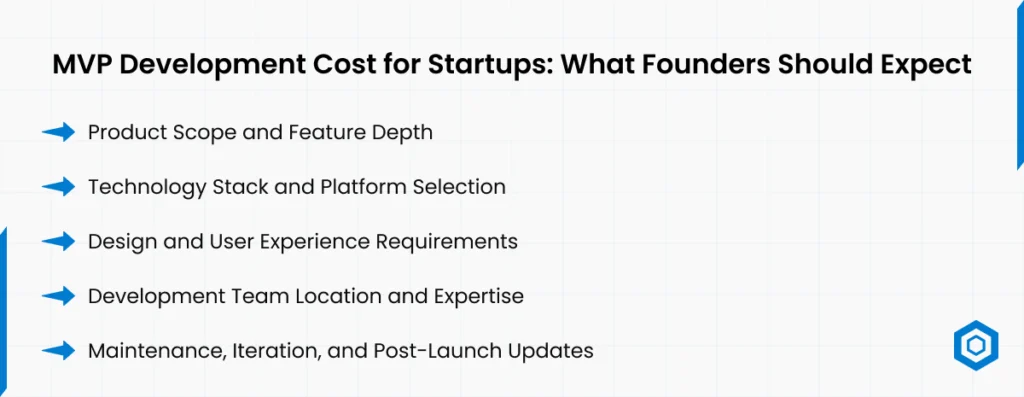
MVP Development Cost for Startups: What Founders Should Expect
Founders need to know the cost of MVP development for startups step by step to set a realistic budget.
1. Product Scope and Feature Depth
Essentially, the number of basic features and their complexity define the cost of MVP. A Minimal Viable Product with one core feature costs much less than an MVP with multiple workflows, integrations, and user roles.
2. Technology Stack and Platform Selection
Web, Mobile, or Cross-platform development affects the total price. Lightweight tools and cloud environments keep overheads down in the early stages while ensuring future-proofing.
3. Design and User Experience Requirements
While UI/UX design services are a critical success factor, they impact the overall budget; high-end animations or custom visuals increase your spend. Startups must strategically balance intuitive usability with lean simplicity when designing their minimum viable product.
4. Development Team Location and Expertise
Teaming up with an experienced team, especially in offshore development, helps a start-up reduce costs without compromising quality. This lowers the barrier to MVP development for fledgling companies.
5. Maintenance, Iteration, and Post-Launch Updates
MVPs should be iterated on because of user feedback. Openness (including the cost of iterations and maintenance we add) is essential for long-term planning and product evolution.
By partnering with a team that offers custom mobile app development services, startups can ensure these roles work in perfect sync to deliver a high-quality product within tight deadlines.
How Startups Can Control MVP Development Costs Without Compromising Quality
Cost control isn’t about taking shortcuts; it’s about making smart development decisions. A methodology can help startups validate ideas effectively without sacrificing quality.
1. Build an MVP
Startups must fight the temptation to load in too many features too soon. A narrow MVP enables quick hypothesis testing and reduces development costs.
2. Adopt an Agile and Iterative Development Model
Startups can use agile development to ship faster and improve. This protects against over-investing in things that users have not yet validated as valuable.
3. Leverage Existing Tools and APIs
Leveraging an identity, analytics, or payment service from someone else shortens the cycle and reduces the time and cost of your own development. This method allows for delivering an MVP app fast and lean!
Why Choose CodeflashInfotech for MVP Development for Startups?
Codeflash Infotech collaborates with startups to quickly turn early-stage concepts into distinctive MVPs for market success. The team knows that MVP development is not about building everything, but about creating the right thing to prove demand and reduce risk.
Absolutely focused on strategy and usability, and quick to market, Codeflash Infotech helps startups take flight quickly and learn faster. Specialising in MVP development for startups, Codeflash Infotech builds scalable, secure, and future-ready solutions that leverage the latest technologies and agile practices.
From product discovery to post-launch iteration, Codeflash Infotech ensures each MVP is consistent with your business goals, users’ needs, and long-term growth plans.
Conclusion
It’s one of the startup risk-mitigation tactics for validating ideas before entering the market quickly, which start-ups rely on today. By adhering to clear steps, such as the MVP development process, focusing on key features, and understanding the cost of an MVP for a startup, founders can make smarter product decisions from the start.
Working with Codeflash Infotech, startups gain access to professional MVP development that delivers speed, clarity, and scale. Startups can build a product ready to prove, pivot, and compete in crowded markets if they have the proper MVP execution with their chosen R&D partner.
Frequently Asked Questions
In MVP development, startups work on their minimum viable products. They create an MVP, the very core of what the product needs to be, to test an idea. It lets startups test market demand, get user feedback, and iterate on the product before scaling.
The MVP process starts with Idea validation, Prioritisation of features, UX design, Development, Testing, and iteration. Each stage focuses on discovering and iterating on product-market fit.
Startup MVP cost depends on the feature set, platform, tech stack, and team. A lean MVP is usually far cheaper to produce than a complete product and serves as an early-stage investment leash.
Table of Content
The Real Purpose of MVP Development for Startups
MVP vs Prototype vs Full Product: What Startups Must Understand
Right Time to Build a Minimum Viable Product
Key Roles Involved in Startup MVP Development
MVP Development Process for Startups: Step-by-Step
Core Features That Every Startup MVP Should Include
How to Build an MVP for a Startup?
Technology Stack Selection for MVP App Development
How MVP Development Helps Reduce Startup Risk
MVP Development Cost for Startups: What Founders Should Expect
How Startups Can Control MVP Development Costs Without Compromising Quality
Why Choose CodeflashInfotech for MVP Development for Startups?