
 Avadh Ladani
Launching a startup is exciting, but turning an innovative idea into a successful product is rarely straightforward. Many founders spend months building feature-rich applications, only to discover that customers need something entirely different. This approach often leads to wasted time, higher development costs, and delayed market entry.
The smarter path is to validate your idea before making a significant investment. That’s where a Minimum Viable Product (MVP) comes in. Instead of building every feature you envision, an MVP focuses on delivering the core value of your product to real users as quickly as possible. It allows startups to gather feedback, test assumptions, and improve the product based on actual user behavior rather than guesswork.
If you’re wondering How to Build an MVP, the answer isn’t about rushing through development—it’s about following a structured process that balances speed, quality, and user validation. With the right planning, many startups can successfully launch a functional MVP within 90 days.
In this step-by-step MVP development guide, you’ll learn how to validate your idea, prioritize essential features, design an intuitive user experience, choose the right technology stack, and prepare for a successful launch. Whether you’re building a SaaS platform, mobile app, marketplace, or AI-powered solution, this roadmap will help you move from concept to a market-ready product with confidence.
A Minimum Viable Product (MVP) is the first usable version of a product that includes only the essential features required to solve a specific problem for its target audience. Rather than investing months developing every possible feature, startups launch with the minimum functionality needed to validate their business idea.
The primary goal of an MVP is learning—not perfection.
By releasing a simplified version of the product, founders can understand how users interact with it, identify pain points, measure demand, and make informed decisions before investing in full-scale development.
For example, a food delivery startup doesn’t need advanced loyalty programs, referral systems, or AI-powered recommendations on day one. Initially, customers only need to browse restaurants, place orders, and make secure payments. Once these core functions are validated, additional features can be introduced based on user feedback.
Many globally recognized companies followed this approach during their early stages. Instead of launching fully developed platforms, they focused on solving one problem exceptionally well and expanded only after validating market demand.
Understanding the difference between these stages helps founders choose the right development approach.
Stage | Purpose | Users |
Prototype | Visualizes ideas and user flows | Internal stakeholders and investors |
Minimum Viable Product (MVP) | Tests market demand with essential functionality | Real customers |
Full Product | Delivers a complete feature set with scalability | Growing customer base |
A prototype demonstrates how a product will work, while an MVP proves whether people actually want to use it.
One of the biggest reasons startups fail is building products that customers don’t need. Developing an entire platform before validating market demand significantly increases financial and operational risks.
Launching an MVP helps founders answer critical questions early:
By answering these questions before scaling, startups make smarter business decisions while reducing unnecessary development effort.
An MVP for Startups also creates opportunities to present a working product to investors, demonstrate traction, and secure funding with greater confidence. Rather than relying solely on presentations or projections, founders can showcase real customer engagement and measurable product performance.
Another important advantage is flexibility. Market expectations evolve quickly, and launching an MVP allows startups to adapt their roadmap based on customer insights instead of assumptions made during the planning stage.
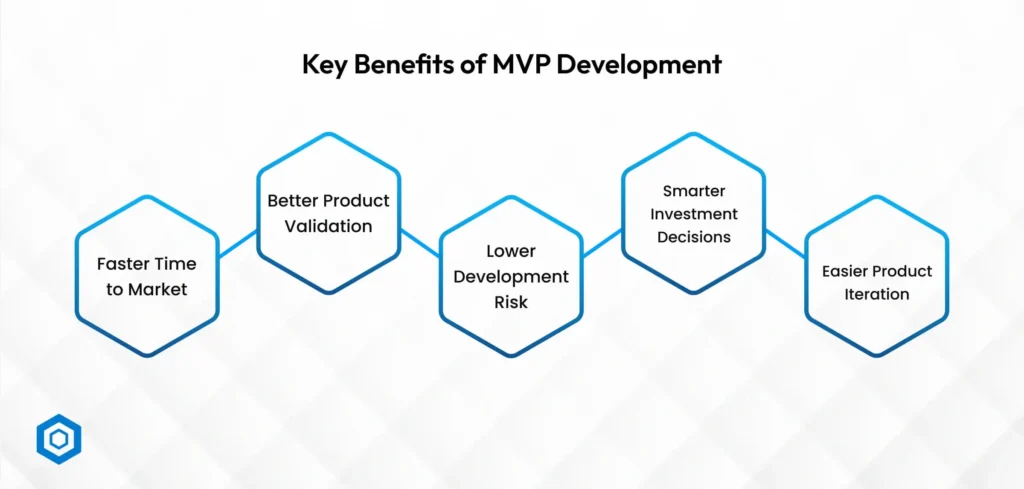
An MVP is more than a basic version of your product—it’s a smart way to validate your idea, reduce risks, and build with real user feedback. Here are the key benefits of starting with an MVP.
Faster Time to Market: Speed is a competitive advantage for startups. An MVP enables you to launch with essential features instead of waiting until every planned functionality is complete. Releasing your product earlier allows you to reach users sooner, gather valuable insights, and refine your offering while competitors are still in development. This early market presence can also help establish your brand and attract initial customers more quickly.
Better Product Validation: Building a product based on assumptions often leads to costly mistakes. An MVP helps validate your business idea by putting it in front of real users and measuring how they interact with it. Instead of relying solely on surveys or predictions, you gain actionable insights into user behavior, feature adoption, and customer expectations. These findings guide future product decisions and reduce the risk of developing features that provide little value.
Lower Development Risk: Developing every feature at once increases complexity, extends timelines, and raises costs. An MVP minimizes these risks by focusing only on the core functionality needed to solve your users’ primary problem. This approach keeps development manageable, simplifies testing, and makes it easier to adapt your product as market needs evolve.
Smarter Investment Decisions: Launching an MVP allows startups to invest strategically rather than committing their entire budget upfront. By validating demand early, founders can make informed decisions about future investments based on real customer feedback and product performance. This phased approach helps optimize resources while reducing financial risk.
Easier Product Iteration: An MVP establishes a foundation for continuous improvement. Once your product is in the hands of users, every interaction provides valuable insights into what works and what needs refinement. This ongoing feedback loop enables startups to prioritize meaningful updates, improve the user experience, and evolve the product in line with changing customer expectations and business goals.
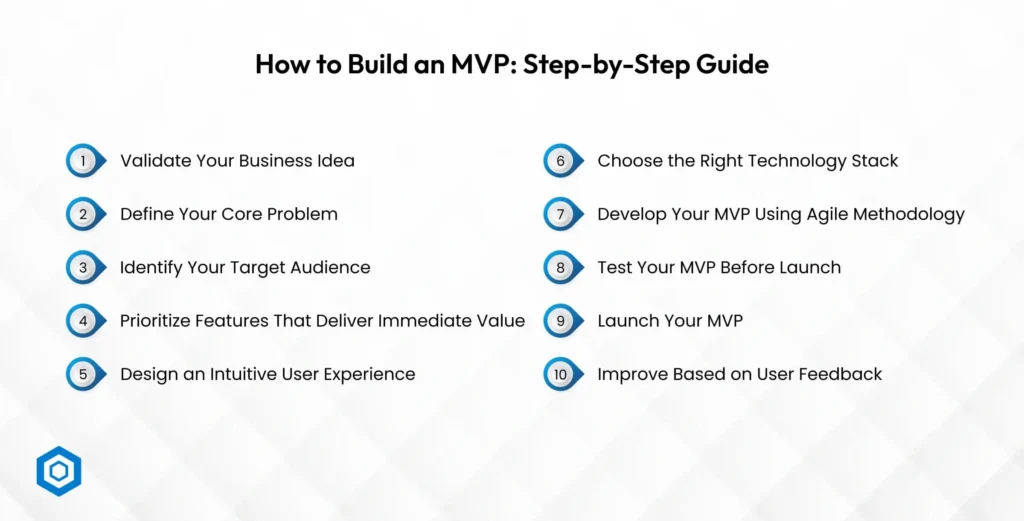
A successful MVP isn’t built overnight. It requires careful planning, strategic prioritization, and consistent execution.
Here’s a proven framework used by successful startup teams.
Before writing code or designing interfaces, validate the problem you’re trying to solve.
Start by researching your target market and identifying whether enough people experience the challenge your product addresses.
Useful validation methods include:
During this stage, focus on understanding customer frustrations rather than selling your solution.
Questions such as these often provide valuable insights:
The answers will help shape your product roadmap while reducing unnecessary assumptions.
One of the most common startup mistakes is trying to solve multiple problems within a single product.
Instead, define one clear objective.
For example:
Instead of building an all-in-one project management platform, focus initially on helping remote teams track daily tasks more efficiently.
This narrow focus simplifies product decisions, reduces development complexity, and improves user adoption during the early stages.
Every feature should contribute directly to solving that primary problem.
If it doesn’t, it can wait for future releases.
Knowing exactly who you’re building for is just as important as knowing what you’re building.
Create detailed customer personas that include:
The more clearly you define your audience, the easier it becomes to prioritize features, create intuitive user experiences, and develop messaging that resonates with potential customers.
Avoid designing for everyone.
Successful products typically solve one specific problem for one specific audience before expanding into broader markets.
Adding too many features is one of the fastest ways to delay product launches.
Instead of asking, “What else should we build?” ask, “What’s the minimum users need to accomplish their goal?”
A simple prioritization framework helps maintain focus.
Priority | Description |
Must Have | Essential features required for the product to function. |
Should Have | Valuable improvements that enhance usability but aren’t necessary for launch. |
Could Have | Nice-to-have features planned for future updates. |
Not Now | Ideas intentionally postponed until customer demand justifies development. |
This structured approach keeps development efficient while preventing unnecessary complexity.
Remember, launching with fewer high-quality features is often more valuable than delaying release for additional functionality.
An excellent user experience doesn’t require hundreds of screens.
It requires clarity.
Before development begins, create:
These visual assets help validate ideas before developers begin implementation, reducing costly revisions later in the project.
Good design focuses on helping users complete tasks with minimal effort.
Ask questions like:
Even the most innovative product can struggle if users find it confusing or difficult to navigate.
Investing time in user experience during the planning stage significantly improves adoption after launch.
Your technology stack has a direct impact on development speed, scalability, maintenance, and future product growth. While it’s tempting to adopt the latest technologies, the best choice depends on your business goals, target audience, and product requirements.
When selecting your stack, consider:
For example, startups building cross-platform mobile applications often choose Flutter to accelerate development for both Android and iOS. Web applications may benefit from React or Next.js for responsive user interfaces, while Node.js is a popular choice for scalable backend development.
Instead of choosing technologies based on trends, select tools that support rapid development while allowing your product to scale as your user base grows.
Once planning and design are complete, development begins.
An Agile approach breaks the project into smaller development cycles called sprints. Each sprint delivers measurable progress while allowing continuous improvements throughout the project.
A typical development cycle includes:
Regular reviews help identify issues early, keeping the project aligned with business objectives and reducing costly revisions later.
Maintaining close collaboration between developers, designers, testers, and stakeholders also ensures everyone is working toward the same product vision.
Testing is an essential phase that ensures your product delivers a reliable experience from day one.
Even a well-designed application can lose users if it contains bugs or performance issues.
A comprehensive testing process should include:
Functional Testing: Verifies that every feature works as expected.
Usability Testing: Evaluates whether users can complete tasks without confusion.
Performance Testing: Measures loading speed, responsiveness, and stability under different conditions.
Security Testing: Protects user data and identifies potential vulnerabilities.
Device and Browser Testing: Ensures consistent performance across different devices and operating systems.
Before launching publicly, invite a small group of beta users to explore the product and provide honest feedback. Their insights often reveal usability improvements that internal teams may overlook.
Launching your MVP doesn’t mean your product is complete—it marks the beginning of the learning process.
Start with a controlled release to collect meaningful feedback before expanding to a larger audience.
Monitor important performance metrics such as:
Tracking these metrics helps you understand whether your product is solving the intended problem and highlights opportunities for improvement.
Remember, successful startups treat launch day as the starting point for continuous product evolution.
The greatest value of an MVP lies in the insights it generates after launch.
Collect feedback through:
Rather than implementing every suggestion, identify recurring patterns that align with your product vision.
Continuous iteration allows your product to evolve according to customer needs instead of assumptions, increasing the likelihood of achieving product-market fit.
Many founders ask whether it’s realistic to launch within three months.
The answer is yes—provided the project scope remains focused and development follows a structured roadmap.
Timeline | Activities |
Week 1 | Market research, competitor analysis, business validation |
Week 2 | Define product goals, user personas, and feature prioritization |
Week 3–4 | Wireframes, UI/UX design, interactive prototypes |
Week 5–8 | Frontend, backend, and API development |
Week 9–10 | Feature completion, integrations, quality assurance |
Week 11 | Beta testing, bug fixing, performance optimization |
Week 12 | Production deployment, launch, analytics setup, and feedback collection |
Following this roadmap demonstrates how to build an MVP in 90 days without compromising product quality or user experience.
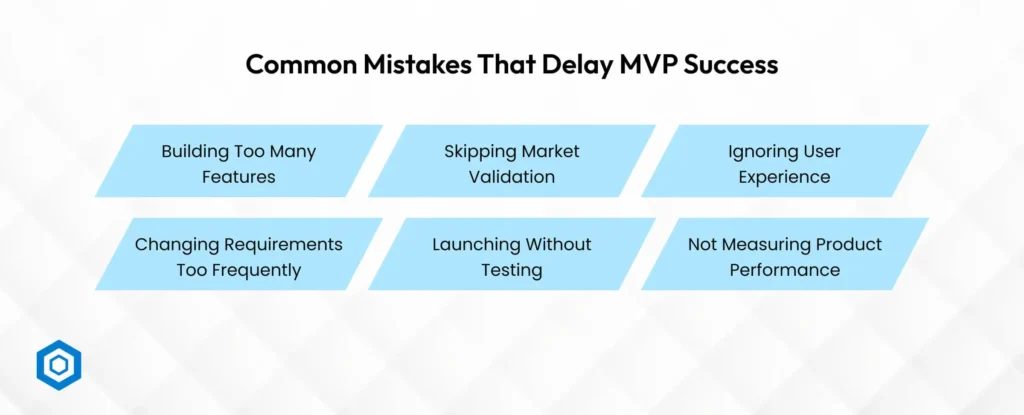
Even experienced founders can make decisions that slow development and reduce product effectiveness.
Avoid these common mistakes:
Building Too Many Features: Trying to create a complete product often delays launch and increases development costs. Focus on solving one problem exceptionally well.
Skipping Market Validation: Building without speaking to potential customers increases the risk of creating a product that nobody needs.
Ignoring User Experience: A complicated interface can discourage users, even if the underlying technology is excellent.
Changing Requirements Too Frequently: Constantly adding new ideas during development disrupts timelines and creates unnecessary complexity.
Launching Without Testing: Releasing a product with unresolved issues damages credibility and reduces customer trust.
Not Measuring Product Performance: Without analytics, it’s impossible to understand how customers interact with your product or identify areas for improvement.
One of the most frequently asked questions from founders is about MVP development cost.
There isn’t a fixed answer because every product has unique requirements. Instead of focusing solely on price, consider the factors that influence the overall investment.
Key cost factors include:
Starting with essential functionality allows startups to validate their ideas before investing in advanced features, making development more predictable and financially manageable.
Successful startups follow a disciplined approach throughout the development process.
Here are some proven best practices:
The goal isn’t to create the perfect product—it’s to create a valuable product that evolves through customer feedback.
Turning an idea into a successful digital product requires more than technical expertise. It takes strategic planning, user-focused design, and efficient execution.
At Codeflash Infotech, we help startups and businesses transform ideas into scalable digital products through a structured MVP development process.
What You Can Expect
From SaaS platforms and AI-powered applications to marketplaces, healthcare solutions, and mobile apps, our experienced team delivers MVPs that are built for performance, scalability, and long-term growth.
Our custom MVP development services are designed to help you validate your idea, launch faster, and build a strong foundation for future product success.
Building a successful MVP is about solving the right problem—not building every possible feature. By validating your idea early, prioritizing essential functionality, and improving through real user feedback, you can reduce risks and launch with confidence.
If you’re looking for an experienced MVP development company for startups, Codeflash Infotech can help you turn your idea into a scalable, market-ready product with a structured and efficient development approach.
Explore answers below or reach out to us for personalized support and further assistance.
Yes, building an MVP in 90 days is achievable when the project scope is clearly defined and focuses on essential features. A structured development process that includes planning, design, development, testing, and launch helps startups release a functional product quickly while maintaining quality.
The first step is validating your business idea. Before development begins, identify the problem you’re solving, research your target audience, analyze competitors, and gather customer feedback. This reduces the risk of building a product that doesn’t meet market needs.
The MVP development cost depends on factors such as product complexity, feature requirements, design, technology stack, third-party integrations, and development timeline. Starting with only the core features helps control costs while allowing room for future improvements.
An MVP should include only the essential features needed to solve your users’ primary problem. Prioritizing core functionality allows startups to launch faster, collect real user feedback, and make informed decisions before expanding the product.
An MVP for startups helps validate business ideas, reduce development risks, and reach the market faster. It enables founders to test assumptions with real users, refine the product based on feedback, and invest in future development with greater confidence.
After launch, startups should monitor user behavior, analyze performance metrics, collect customer feedback, and continuously improve the product. Regular updates based on real user insights help move the product closer to achieving product-market fit.