
 Avadh Ladani
Artificial intelligence is transforming the fitness industry with personalized workouts, real-time coaching, and data-driven insights. As demand for smarter fitness experiences continues to grow, businesses are investing in AI-powered applications that improve user engagement and deliver long-term value.
Building a successful AI fitness app requires more than adding intelligent features. It involves the right strategy, technology stack, scalable architecture, and a user-focused development approach.
In this step-by-step guide, you’ll learn how to build an AI fitness app in 2026, including essential features, the development process, recommended technologies, development costs, and key market trends.
Building an AI fitness app involves defining your niche, selecting essential AI features, choosing the right technology stack, developing an MVP, integrating AI models, testing thoroughly, and launching a scalable product. Development costs typically range from $25,000 to $180,000 depending on complexity.
The fitness app market has become increasingly competitive, but AI creates opportunities to deliver experiences that traditional applications cannot match. Instead of offering identical workout plans to every user, AI analyzes personal preferences, activity history, recovery patterns, and fitness goals to provide recommendations that improve over time.
For businesses, this personalization leads to stronger user engagement, higher retention rates, and recurring subscription revenue.
Some of the key advantages include:
As consumers continue to prioritize health and wellness, AI-powered fitness applications are becoming a preferred choice across global markets.
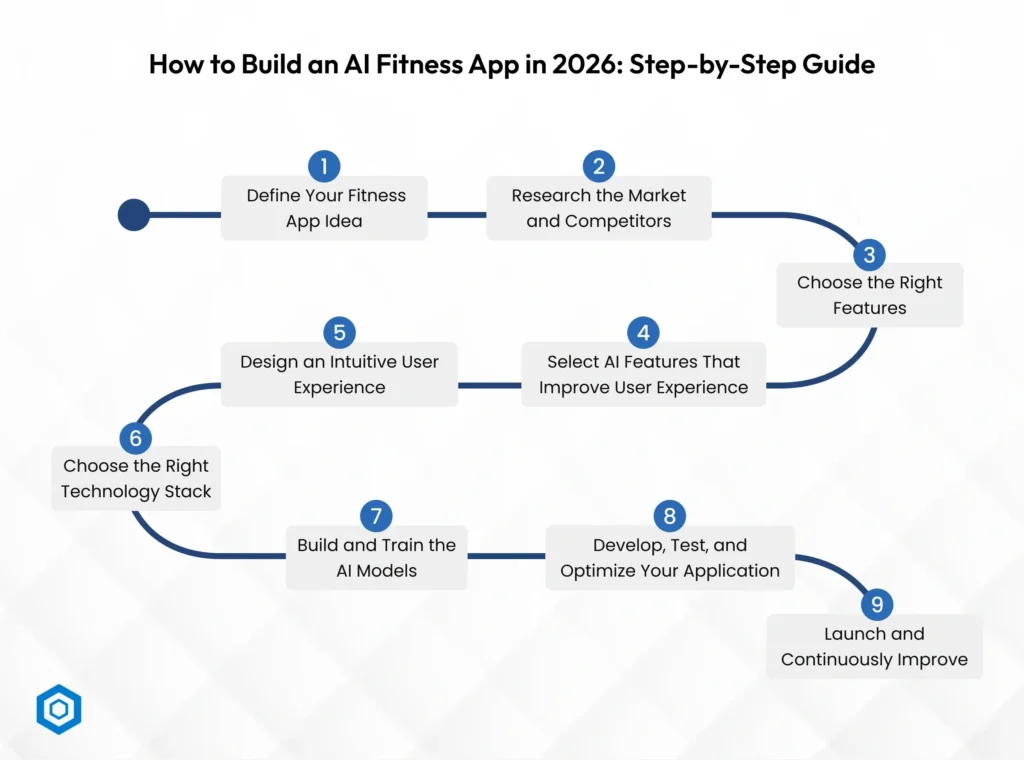
Every successful product starts with solving a real problem. Before writing code, identify the audience you want to serve and understand their expectations.
Ask yourself questions such as:
Your product may focus on weight management, strength training, yoga, running, rehabilitation, home workouts, or corporate wellness. Defining a clear niche allows you to build a more focused and competitive application.
Understanding the market helps you identify feature gaps and opportunities for innovation. Study leading fitness platforms to learn what users appreciate and where improvements can be made.
During competitor analysis, evaluate:
This research helps prioritize features that align with user expectations while avoiding unnecessary complexity during the initial launch.
The functionality of your application plays a significant role in user satisfaction. Instead of launching with dozens of features, focus on capabilities that provide measurable value.
Essential features include:
Personalized User Profiles: Collect information such as age, weight, height, fitness level, goals, workout preferences, and available equipment. This data allows AI models to generate tailored recommendations from the beginning.
AI Workout Recommendations: Rather than assigning fixed workout plans, AI analyzes user behavior and automatically adjusts routines based on progress, consistency, and performance.
Smart Progress Tracking: Allow users to monitor calories burned, workout history, active days, body measurements, and overall fitness improvements through interactive dashboards.
Nutrition Planning: Nutrition directly impacts fitness outcomes. Integrating meal recommendations, calorie tracking, hydration reminders, and macro calculations provides a more complete wellness experience.
Wearable Integration: Connecting devices such as smartwatches and fitness trackers enables the application to collect heart rate, sleep quality, step count, and activity data, improving recommendation accuracy.
Notifications and Reminders: Intelligent reminders encourage users to complete workouts, maintain hydration, and stay consistent without overwhelming them with unnecessary alerts.
Artificial intelligence should enhance the overall experience rather than complicate it. Every AI capability should solve a practical problem for the user.
Popular AI features include:
AI Personal Trainer: Provides customized workout plans, motivational coaching, exercise recommendations, and fitness guidance based on individual progress.
Exercise Form Detection: Computer vision technology analyzes body posture through the smartphone camera and provides feedback to improve exercise technique and reduce injury risk.
Conversational AI Assistant: Users can ask questions about workouts, nutrition, recovery, or fitness goals and receive contextual responses without searching through menus.
Predictive Analytics: Machine learning identifies behavioral patterns and predicts future performance, helping users maintain consistency and avoid workout plateaus.
Recovery Recommendations: Based on workout intensity, sleep data, and activity levels, AI can recommend recovery days or lighter training sessions to improve long-term performance.
An advanced AI engine cannot compensate for poor usability. A clean interface encourages users to complete workouts, explore features, and remain engaged over time.
Prioritize simplicity throughout the design process by focusing on:
Reducing unnecessary complexity improves both user satisfaction and retention.
The technology stack determines your application’s scalability, performance, and long-term maintenance costs.
A modern AI fitness app typically includes:
Technology Layer | Recommended Technologies |
Frontend | Flutter, React Native, Swift (iOS), Kotlin (Android) |
Backend | Node.js, NestJS, Python, Django |
Database | PostgreSQL, MongoDB |
Cloud Infrastructure | AWS, Google Cloud, Microsoft Azure |
AI & Machine Learning | OpenAI APIs, Google Gemini, TensorFlow, PyTorch, MediaPipe (Pose Estimation) |
Choosing technologies based on project requirements rather than trends helps create a scalable and maintainable application.
Artificial intelligence is what differentiates a modern fitness app from a traditional workout application. The effectiveness of your AI features depends on the quality of the data, the machine learning models, and how they improve over time.
For example, an AI recommendation engine can analyze workout history, activity levels, and user goals to suggest exercises that match each person’s fitness journey. Similarly, computer vision models can detect body posture and provide real-time feedback during workouts.
Instead of trying to develop every AI capability from scratch, many businesses start by integrating trusted AI services and then gradually build proprietary models as their user base grows.
It’s equally important to monitor model performance regularly. User behavior changes over time, and AI models should evolve to deliver accurate and relevant recommendations.
After finalizing the product requirements and AI capabilities, the development phase begins. This stage involves building the mobile application, backend services, APIs, admin dashboard, and AI integrations.
A typical development workflow includes:
Quality assurance should be performed throughout development instead of waiting until the final release.
Testing should cover:
Launching with a reliable product creates a stronger first impression and reduces costly post-release fixes.
Launching your application is only the beginning. The most successful AI fitness apps improve continuously based on user feedback and analytics.
Track key performance indicators such as:
These insights help prioritize future updates and refine AI recommendations based on real-world usage.
One of the most common questions businesses ask is how much it costs to build an AI fitness app.
The answer depends on factors such as feature complexity, AI capabilities, platform selection, integrations, and your development team’s location.
App Type | Estimated Cost |
MVP with Essential Features | $25,000 – $45,000 |
MVP with Essential Features | $45,000 – $80,000 |
Advanced AI Fitness Platform | $80,000 – $180,000+ |
A simple MVP generally includes personalized onboarding, workout plans, progress tracking, and subscription management.
A more advanced application may include:
While advanced features increase the initial investment, they also improve user engagement and long-term business value.
The project timeline depends on the scope of features and team size.
Development Stage | Estimated Duration |
Discovery & Planning | 2–3 Weeks |
UI/UX Design | 3–4 Weeks |
MVP Development | 10–14 Weeks |
AI Integration | 4–6 Weeks |
Testing & QA | 3–4 Weeks |
Deployment | 1 Week |
An MVP can typically be launched within 4–6 months, allowing businesses to validate their idea before investing in advanced functionality.
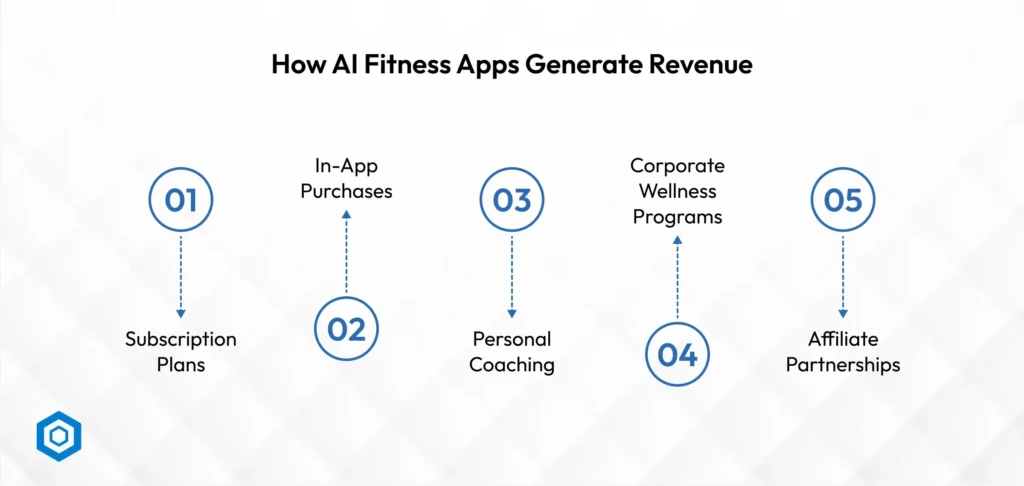
A strong monetization strategy is essential for long-term success. Instead of relying on a single revenue stream, many successful fitness platforms combine multiple business models.
Popular monetization options include:
Subscription Plans: Offer monthly or annual memberships that unlock premium workouts, AI coaching, nutrition guidance, and advanced analytics.
In-App Purchases: Users can purchase personalized workout programs, meal plans, or one-time fitness challenges.
Personal Coaching: Allow certified trainers to offer virtual coaching sessions through the platform.
Corporate Wellness Programs: Partner with organizations that provide fitness benefits to employees.
Affiliate Partnerships: Recommend fitness equipment, supplements, wearable devices, or healthy food products through affiliate programs.
Diversifying revenue sources helps create a more sustainable business model.
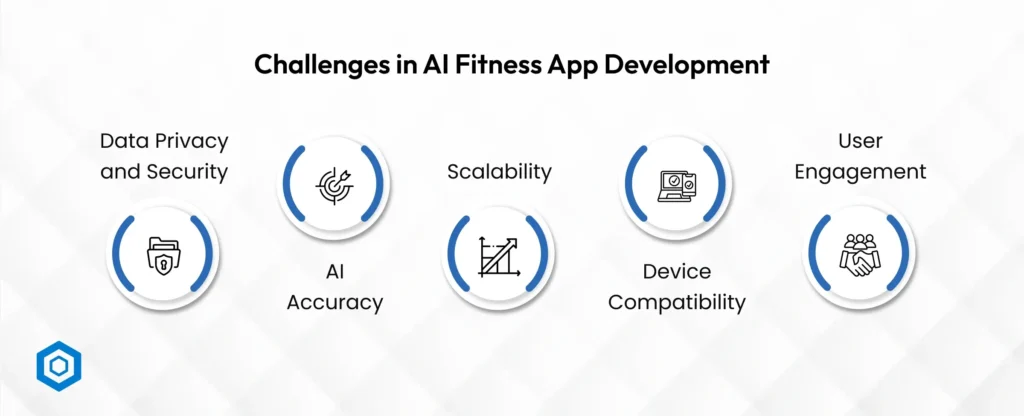
Building an AI-powered fitness application involves technical and operational challenges that should be addressed early in the project.
Data Privacy and Security: Fitness applications collect sensitive health information. Compliance with privacy regulations and strong data encryption are essential for protecting user trust.
AI Accuracy: Poor recommendations can reduce user confidence. AI models should be continuously evaluated and refined using quality data.
Scalability: As the user base grows, the application should handle increased traffic without affecting performance.
Device Compatibility: Users expect a consistent experience across smartphones, tablets, smartwatches, and wearable devices.
User Engagement: Even the most advanced AI features won’t succeed if users stop returning. Regular updates, personalized content, and community-driven experiences help improve retention.
Planning for these challenges from the beginning can reduce development risks and support long-term growth.
The future of digital fitness is being driven by intelligent, connected, and highly personalized experiences. The global fitness app market is expected to grow from USD 13.9 billion in 2026 to USD 33.6 billion by 2033, reflecting the increasing demand for AI-powered fitness solutions, personalized coaching, and digital wellness platforms. The rapid adoption of wearable devices and smart health technologies is also accelerating innovation in AI fitness app development.
Some of the most promising trends include:
Businesses that embrace these innovations will be better positioned to meet evolving user expectations, improve engagement, and stay competitive in the rapidly growing digital fitness market.
Building an AI fitness app requires expertise in mobile development, cloud infrastructure, artificial intelligence, UI/UX design, and data security. Working with an experienced development partner can reduce technical risks and accelerate time to market.
When evaluating a development company, consider:
At Codeflash Infotech, we help startups, fitness brands, and wellness businesses build scalable AI fitness apps. As a trusted AI development company, we deliver end-to-end solutions—from strategy and design to AI integration, development, and deployment.
Selecting the right partner ensures your application is built with scalability, performance, and future growth in mind.

AI fitness apps are redefining digital wellness through personalized workouts, intelligent coaching, and data-driven experiences. Building a successful app requires the right strategy, essential features, a scalable technology stack, and a trusted AI development consulting partner. Whether you’re launching an MVP or a full-featured platform, investing in AI fitness app development in 2026 can help your business meet growing market demand and achieve long-term growth.
Explore answers below or reach out to us for personalized support and further assistance.