What Is an Enterprise Application? Types, Features & Benefits Explained
30 January
Introduction
As a company grows, it adds more departments, locations, and internet channels, which makes things more difficult. Statista says the global market for business software is still growing rapidly.
Statista predicts that the global enterprise software market will grow by 6.55% between 2024 and 2028, reaching $376.4 billion, underscoring the importance of enterprise applications to modern enterprises.
Businesses are investing in uniform systems that help them operate more safely, be more productive, and make better decisions. This growth is clear evidence that workplace applications are critical to businesses today.
Enterprise apps are an essential part of the digital transformation for businesses of all sizes, from small businesses just starting to large corporations handling large numbers of people. We will discuss what an enterprise application is, how it works, and why companies need enterprise software solutions to grow in the long term.
What Is an Enterprise Application?
An enterprise application is a large piece of software designed to automate the most critical business tasks across an entire company. These programs can handle complex workflows, diverse user roles, large volumes of data, and high security requirements.
What a business application does and how big it is tell you what it is. On the other hand, enterprise applications are designed to meet the needs of the entire company and integrate with business tools, processes, and data sources.
What Is an Enterprise Application With Examples?
To get a better idea of what an enterprise application is and how it works, consider the systems businesses use every day to run their processes smoothly. These apps aren’t separate tools; they’re connected systems that help people make decisions and work together.
1. Enterprise Resource Planning (ERP)
With an ERP system, buying, inventory, management, the supply chain, and banking are all done on the same platform. They help companies keep their data accurate, save time on manual chores, and see right away how their companies are doing.
2. Customer Relationship Management (CRM)
CRM software consolidates all your customer information, sales leads, marketing efforts, and customer service interactions in one place. These tools help sales and customer service teams work more effectively and involve customers more in the business.
3. Human Resource Management Systems (HRMS)
HRMS programs track employee records, payroll, hiring, performance reviews, and compliance. They make HR tasks easier and ensure that everyone on a large or geographically dispersed team is doing the same thing.
4. Business Intelligence (BI) and Analytics
BI tools analyse data from many different business systems to identify trends. These tools help you plan your strategy by turning raw data into screens, reports, and predictive analytics.
5. Supply Chain Management (SCM)
SCM enterprise apps handle logistics, purchasing, inventory tracking, and supplier management. They help businesses reduce delays, optimise costs, and maintain supply chain visibility.
Each of these systems qualifies as an enterprise application because it supports large user bases, complex processes, and cross-departmental collaboration
Why Enterprise Applications Matter for Modern Businesses?
Businesses increasingly need enterprise apps as they move away from disconnected tools and manual workflows. They give groups a structured digital foundation that enables them to operate effectively at scale.
Businesses can respond more quickly to market changes, reduce operational issues, and improve internal collaboration by using corporate software solutions. Because of this, developing business apps is more of a long-term investment than a technical upgrade.
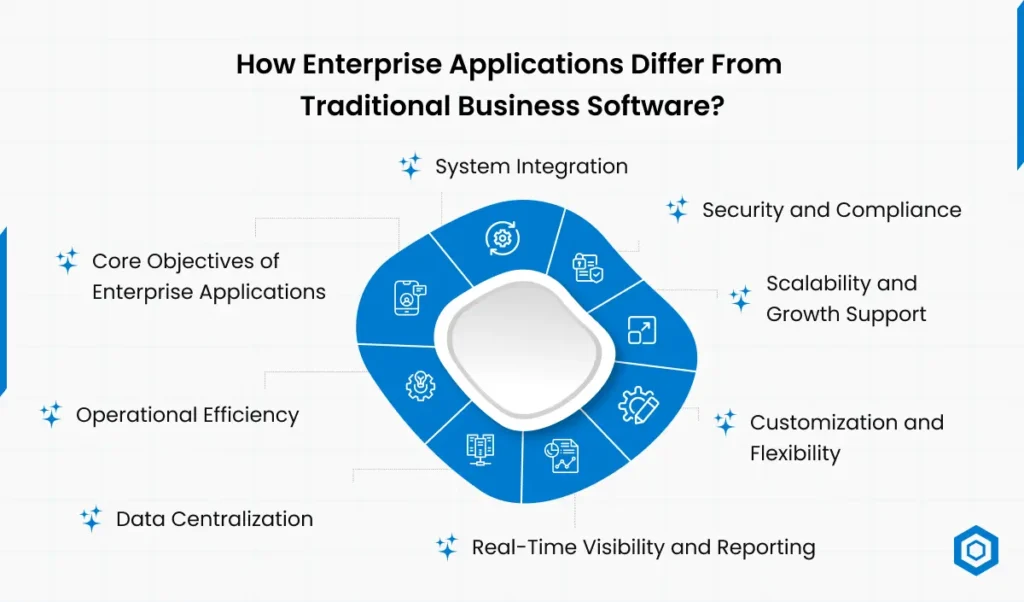
How Enterprise Applications Differ From Traditional Business Software?
Most of the time, traditional business software is made for small teams and narrow use cases. Most of the time, these tools don’t have the scalability, advanced integrations, or firm security limits that growing businesses need.
Business applications, on the other hand, are designed to support operations across the entire business. They can be used in complex business environments because they provide role-based access, can be scaled up or down, and can be changed over time.
1. Core Objectives of Enterprise Applications
When building enterprise applications, clear strategy goals ensure that technology aligns with the business’s objectives. Every goal directly leads to better performance and long-term security.
2. Operational Efficiency
Enterprise applications simplify repetitive tasks that take a lot of time across departments. People will make fewer mistakes, work will be done faster, and teams will have more time to focus on critical tasks instead of doing things by hand.
3. Data Centralization
One of the main goals of business applications is to consolidate all a company’s data into a single location. A single source of truth ensures that all of a company’s teams can access, use, and agree on the same data.
4. Scalability and Growth Support
Business apps can grow with the company. The number of people, the amount of data, and operational needs keep increasing, yet these systems still work well. Yet they do not need to be overhauled, wholesale.
5. Security and Compliance
Security is a fundamental objective of enterprise application development. To keep private business data safe, these apps have advanced access controls, encryption, audit trails, and compliance features.
6. System Integration
The tools and sites that businesses use today are numerous. Enterprise apps are designed to connect easily with other apps, enabling data sharing and process integration.
7. Real-Time Visibility and Reporting
Real-time dashboards and analytics in enterprise software help leaders monitor performance. This visibility helps all business departments make faster, more data-driven decisions.
8. Customisation and Flexibility
Each business operates differently, and each has its own needs. Companies can customise the features, workflows, and interfaces of business apps to make them as helpful as possible.
Types of Enterprise Applications
There is a wide variety of enterprise apps, all designed to perform specific business-related tasks while functioning as a single system. These aspects of business tools are most essential because they enable teams to collaborate, work more efficiently, and make data-driven decisions.
1. Enterprise Resource Planning (ERP) Applications
An ERP system encompasses a broad vision of serving customer needs, including planning, purchasing, inventory management, product production, and operations.
When you mix data and workflows, you eliminate unnecessary copies, ensure everything is correct, and see how the whole business is performing in real time. It’s for this reason that they are favourites for crafting office equipment.
2. Customer Relationship Management (CRM) Applications
CRM enterprise tools enable marketing, sales, and customer service teams to track every interaction a customer has with their organisation.
Because of these tools, departments can communicate with one another, track leads and opportunities, and share customer information in a single location. It helps businesses nurture customer relationships and grow revenue.
3. Human Resource Management Systems (HRMS)
Enterprise human resources apps are built to manage the entire employee lifecycle, including recruitment, training, payroll, performance reviews, and compliance with all regulations.
By automating HR tasks and maintaining accurate employee records, HRMS software helps businesses increase worker productivity and ensure regulatory compliance at scale.
4. Supply Chain Management (SCM) Applications
Tools to manage the supply chain. Enterprise tools for supply chain management aid in logistics, demand planning, purchasing, and inventory management.
These systems provide visibility into the supply chain, reduce operational lag time, and save businesses money, while ensuring that internal teams and external partners work together effectively.
5. Business Intelligence (BI) and Analytics Applications
Enterprise business intelligence apps employ dashboards, reports, and analytics to extract valuable data from a wide range of business tools. Businesses can use these apps to monitor performance, identify trends, and make informed decisions based on real-time data, enabling better planning.
6. Enterprise Content Management (ECM) Applications
Enterprise Content Management apps allow all employees of a company to create, store, organise, and retrieve digital files and content. Many companies have a lot of data to deal with. They ensure those companies can handle that data securely and track different versions of documents.
7. Enterprise Asset Management (EAM) Applications
Enterprise Asset Management applications are used to track, maintain, and optimise physical assets such as machinery, equipment, and infrastructure. These apps help businesses reduce downtime and extend the life of key assets by showing how they perform and when they need maintenance.

Key Features of Enterprise Applications
These days, business apps have advanced features that make them safer, more flexible, and scalable as needed. These parts set corporate software apart from simple business tools and ensure it works well in complex business settings.
1. Scalability and Performance
Business apps have this built in so they can handle more users, deals, and data without slowing down. Their design is scalable, meaning the system will continue to work well as businesses grow and move operations to other areas.
2. Security and Access Control
Many security features are built into business apps, including encryption, authentication, and role-based access control. These safeguards keep private company data secure and ensure users can only see the data necessary for their jobs.
3. Integration Capabilities
Enterprise apps can work with third-party platforms, legacy software, and existing systems. It is simple for data to move between business environments when they can connect. This creates a single digital infrastructure.
4. Customisation and Flexibility
There are plenty of ways for businesses to customise such corporate apps to fit their systems and workflows. This way, code tailored to the company can be agile without the hassle of constantly bringing in new systems.
5. Reliability and Availability
Those who work for enterprises that depend on software for daily work need enterprise applications that are always available and reliable. Backing up, copying, and redundancy ensure that critical systems are always available and fail infrequently.
6. Centralised Reporting and Monitoring
If you’re providing enterprise apps to companies, they’ll be able to track usage, performance metrics, and operational results. Those findings make it more likely that problems are nipped in the bud and that improvements to business software solutions are made continuously.
7. Continuous Support
Apps have always been products that businesses build to improve and add features. Over time, making software this way ensures it can adapt to changes in technology and customer needs.
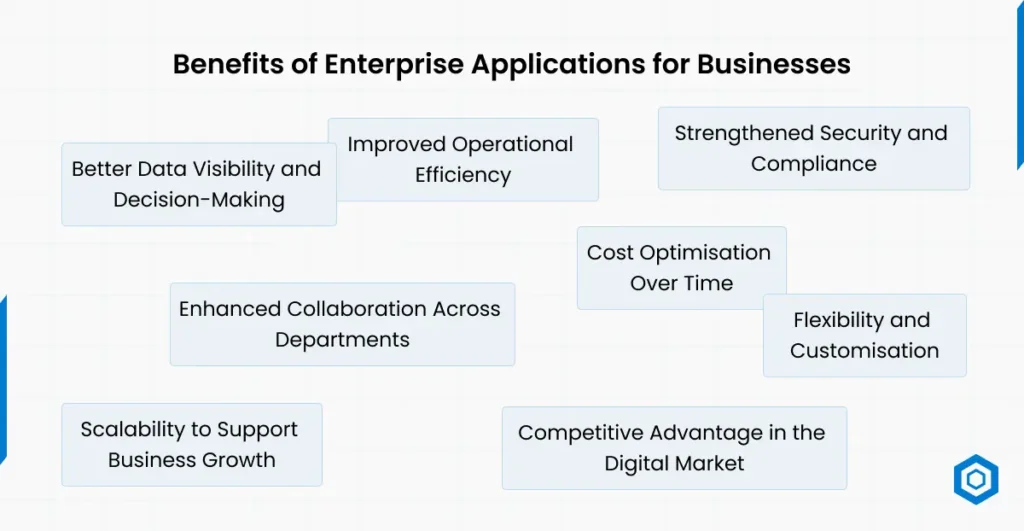
Benefits of Enterprise Applications for Businesses
Understanding how workplace applications benefit enterprises is key for leaders to understand why these systems are essential for sustainable success. Enterprise applications enable the easy flow of information, allowing businesses to effectively organise their processes, data, and operations across departments in an organised, concise manner.
1. Improved Operational Efficiency
One of the best things about enterprise applications is that they make the whole company more efficient. Enterprise software solutions automate routine tasks and standardise methods so that people don’t have to do them by hand. This means teams can focus on big projects rather than small ones.
2. Better Data Visibility and Decision-Making
Enterprise software keeps all a business’s data in one place so that users can access it at any time. The point is that leadership teams can now more easily see performance data, enabling faster, more informed decisions. This is especially critical in high-speed, dynamic business settings.
3. Enhanced Collaboration Across Departments
Business apps bring teams to the same table, offering one place to work more efficiently together and a faster way to get things done. Teams within a company that use the same system can communicate well. No more “silos,” and everyone gets along better.
4. Scalability to Support Business Growth
As a business grows, its policies need to grow with it. Business-critical apps should be scalable and predictable as additional users, transactions, or processing are incorporated, with no loss in performance or quality. It signals that they are the best option for both small businesses and growing enterprises.
5. Strengthened Security and Compliance
More than ever, business is concerned with security and compliance. Enterprise apps include out-of-the-box security features, including role-based access controls, encryption, and audit trails. These capabilities will help businesses adhere to regulatory requirements and protect critical data.
6. Cost Optimisation Over Time
It may be an initial investment, but for most companies, building quality, market-enabled applications isn’t expensive in the long run. If an organisation can streamline work efforts and do more with less, that will also keep costs down and improve ROI.
7. Flexibility and Customisation
Because enterprise apps can be customised, a business can tweak processes, features, and integrations to match its commercial needs as closely as possible. This flexibility ensures that business software can adapt easily to new business models and industry demand.
8. Competitive Advantage in the Digital Market
Businesses using business apps can also work together more effectively and respond faster to market changes, giving them an advantage over competitors.
These instruments make companies more innovative and flexible, and provide a better experience for their customers. The latter enables them to succeed in the long run in the digital economy.
Why Choose CodeflashInfotech for Enterprise Application Development
When it comes to business application development, you are making a choice not only with the right partner but also with the right technology. Codeflash Infotech develops robust, scalable, and secure enterprise apps to help companies consistently meet their organisational goals.
Codeflash Infotech excels at developing one-of-a-kind business software solutions tailored to a company’s specifications, industry standards, and anticipated future growth goals.
A lot of attention is paid to quality, security, and environmental fit as the team ensures that each business application supports long-term operational efficiency and digital transformation goals.
Conclusion
With everything going digital, companies are expected to be able to grow, become more efficient, and make data-driven decisions, all of which can only happen if you have enterprise apps. What is an enterprise application? And in enterprise applications, it’s easy to see how custom software solutions thrive.
When you collaborate with Codeflash Infotech, your enterprise will receive flexible, tailored enterprise application development solutions to maintain growth, security, and agility in a highly competitive business environment.
With the right enterprise application strategy and development partner, enterprises can design intelligent systems that drive lasting value growth and a competitive edge.
Frequently Asked Questions
An enterprise application is a large-scale software system designed to support and automate core business processes across an organisation. Unlike basic software tools, enterprise applications are built to handle complex workflows, multiple user roles, high data volumes, and integration with other enterprise systems.
ERP for finance and operations, CRM for customer management, HRMS for personnel management, and BI tools for analysis are business applications. They boost company-wide processes and make departmental collaboration easier.
ERP, CRM, HRMS, Supply Chain Management, Business Intelligence, and ECM are the most common business applications. Each category serves a different purpose for firms and works together as a corporate software ecosystem.
Companies can use office applications to simplify processes, visualise data, improve collaboration, and help scale their operations while ensuring their IT environments remain secure. These applications assist companies in reducing manual work, becoming more decision-making empowered, and becoming scalable in the future.
Here’s how enterprises can succeed in developing business applications by building nimble, custom systems tailored to their specific needs. These applications streamline the management of growing numbers of users, data, and workflows while preserving performance, availability, and security as operations scale.
Table of Content
What Is an Enterprise Application?
What Is an Enterprise Application With Examples?
Why Enterprise Applications Matter for Modern Businesses?
How Enterprise Applications Differ From Traditional Business Software?
Types of Enterprise Applications
Key Features of Enterprise Applications
Benefits of Enterprise Applications for Businesses
Why Choose CodeflashInfotech for Enterprise Application Development