AI in Customer Success: Benefits, Use Cases & Tips
AI in Customer Success: Benefits, Use Cases & Tips
13 FEBRUARY
In today’s competitive digital landscape, delivering exceptional customer experiences is no longer optional; it’s essential. Businesses that fail to understand customer needs, predict issues, and personalize engagement risk losing users to more agile competitors. This is where AI in customer success is making a powerful impact. According to insights fromMcKinsey & Company, companies leveraging AI-driven customer engagement significantly improve operational efficiency and customer satisfaction.
At Codeflash Infotech, we help businesses implement scalable AI development services that transform customer success into a proactive growth engine. Artificial Intelligence is transforming how companies manage relationships, improve retention, and scale support operations. From predictive analytics to AI-powered chatbots, customer success teams are now equipped with smarter tools that automate processes and deliver deeper insights.
In this blog, we explore the benefits of AI for customer success, real-world examples, best practices, and implementation strategies for businesses looking to stay ahead.
What Is AI in Customer Success?
AI in customer success refers to using artificial intelligence technologies—such as machine learning, natural language processing (NLP), and predictive analytics—to enhance customer interactions and outcomes.
Instead of relying on manual tracking and reactive support, AI enables businesses to:
Anticipate customer needs
Automate engagement
Personalize communication
Predict churn
Optimize onboarding
This shift turns customer success from a reactive function into a proactive, data-driven growth engine.
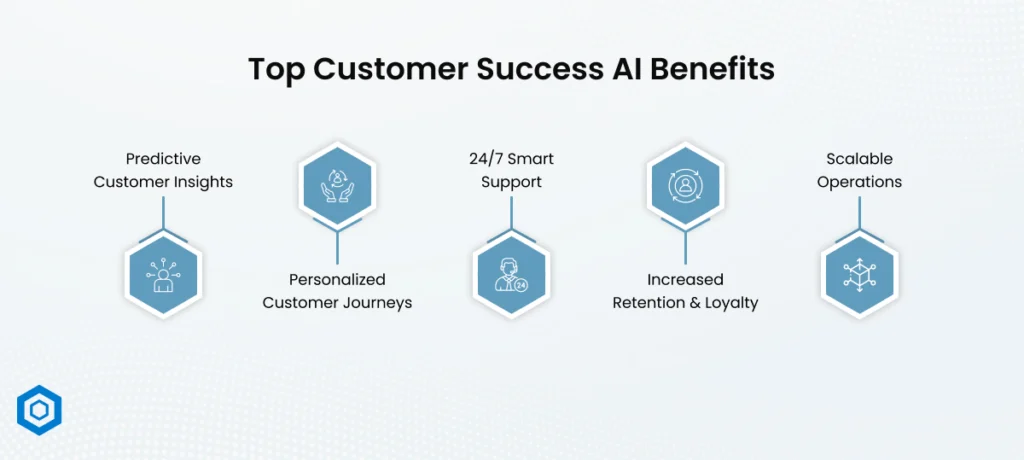
Top Customer Success AI Benefits
Implementing AI-powered customer success tools offers several measurable advantages:
1. Predictive Customer Insights
AI analyzes user behavior, usage patterns, and engagement data to predict customer satisfaction and churn risks. This allows teams to take action before problems occur.
2. Personalized Customer Journeys
AI helps deliver hyper-personalized content, product recommendations, and communication tailored to individual customer needs.
3. 24/7 Smart Support
AI chatbots and virtual assistants provide instant responses, reducing response time and improving customer satisfaction.
4. Increased Retention & Loyalty
By proactively resolving issues and delivering consistent value, businesses experience higher customer retention rates.
5. Scalable Operations
AI automates repetitive tasks, enabling customer success teams to manage thousands of users without increasing costs.
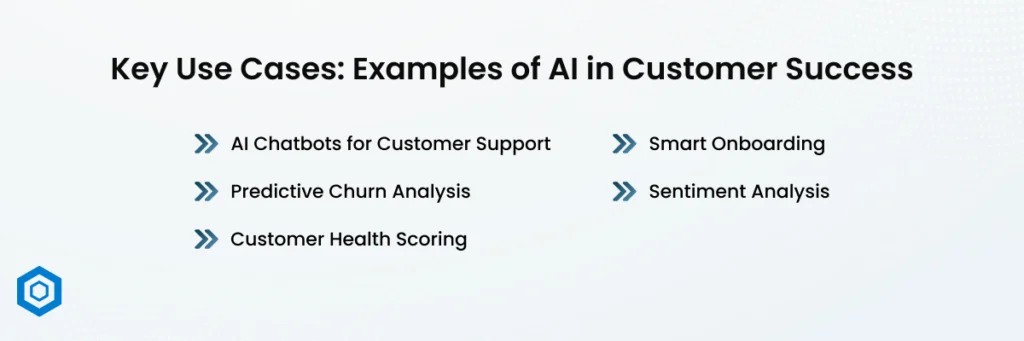
Key Use Cases: Examples of AI in Customer Success
Here are practical examples of AI in customer success across industries:
1. AI Chatbots for Customer Support
AI-powered chatbots handle common queries, resolve tickets, and escalate complex issues to human agents.
2. Predictive Churn Analysis
Machine learning models identify customers likely to churn and trigger automated retention campaigns.
3. Customer Health Scoring
AI calculates real-time health scores based on usage, engagement, and support history.
4. Smart Onboarding
AI guides new users with personalized walkthroughs and in-app recommendations.
5. Sentiment Analysis
NLP tools analyze customer messages, reviews, and feedback to measure sentiment and satisfaction levels.
AI Chatbots in Customer Success
AI chatbots play a crucial role in modern customer success strategies. Unlike traditional scripted bots, AI chatbots use machine learning and natural language processing to understand customer intent and respond intelligently.
These chatbots continuously learn from conversations, making them more accurate and helpful over time.
How AI Chatbots Add Value
AI-powered chatbots support customer success by:
Providing instant answers to common questions
Reducing support ticket volume
Offering 24/7 assistance across web and mobile platforms
Guiding users through onboarding processes
Collecting customer feedback automatically
By implementing AI chatbots, businesses can improve response times, enhance user satisfaction, and maintain consistent engagement without increasing operational costs.
Real-World Applications
AI chatbots are commonly used for:
SaaS product onboarding
E-commerce order tracking
Technical support
Appointment scheduling
Customer feedback collection
This makes chatbots one of the most effective AI-powered customer success tools for scaling customer operations.
Best AI-Powered Customer Success Tools
Some of the most popular AI-powered customer success tools include:
Zendesk AI
HubSpot Service Hub
Gainsight PX
Intercom
Freshdesk AI
Salesforce Einstein
These platforms use AI to automate workflows, improve customer engagement, and provide predictive insights.
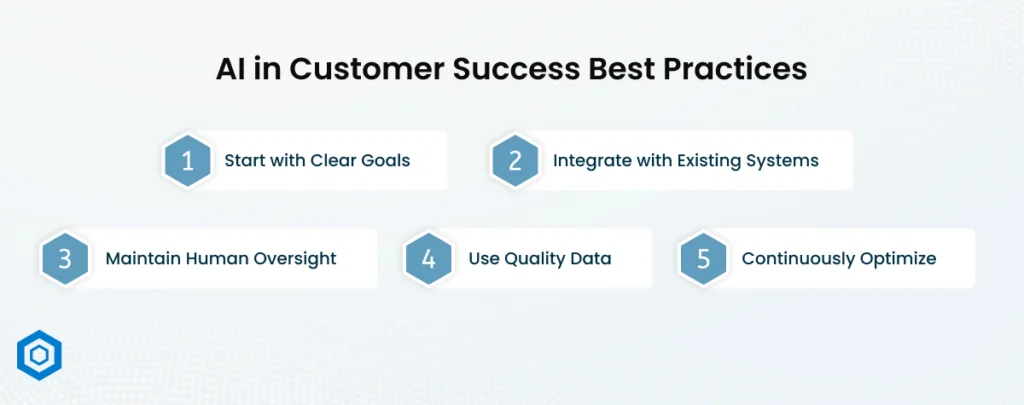
AI in Customer Success Best Practices
To maximize ROI, follow these AI in customer success best practices:
1. Start with Clear Goals
Define your focus: retention, onboarding, upselling, or support automation.
2. Integrate with Existing Systems
AI performs best when integrated with CRM, analytics, and support platforms.
3. Maintain Human Oversight
AI should support—not replace—human decision-making.
4. Use Quality Data
AI outcomes depend on accurate and clean customer data.
5. Continuously Optimize
Regularly train AI models to adapt to evolving customer behavior.
How to Implement AI in Customer Success (Step-by-Step)
Here’s a simple roadmap for successful implementation:
Identify pain points in your customer journey.
Choose the right AI-powered tools.
Integrate with your CRM and analytics.
Train your team
Monitor performance and improve.
If you’re looking for a trustedAI software development company, Codeflash Infotech can help you design and implement intelligent automation tailored to your business.
Why Codeflash Infotech for AI Customer Success Solutions?
At Codeflash Infotech, we specialise in building intelligent, scalable AI solutions tailored for customer-centric businesses.
Our AI services include:
Custom AI chatbot development
Predictive analytics solutions
CRM automation with AI
Customer behaviour modelling
AI-powered SaaS integrations
We help startups and enterprises leverage AI to improve customer experience, retention, and revenue growth.
Future of AI in Customer Success
The future of customer success will be:
Fully predictive
Hyper-personalized
Voice and emotion-driven
Powered by real-time AI analytics
Businesses that adopt AI early will gain a massive competitive advantage.
AI-Powered Customer Success: The Way Forward
AI is no longer a luxury—it’s a necessity for modern customer success teams. By adopting AI in customer success, businesses can automate workflows, predict customer behaviour, and deliver exceptional experiences at scale.
Whether you’re a SaaS startup or a growing enterprise, leveraging customer success AI benefits will help you build stronger relationships, reduce churn, and drive long-term growth.
Conclusion
AI is no longer a luxury—it’s a necessity for modern customer success teams. By adopting AI in customer success, businesses can automate workflows, predict customer behavior, and deliver personalized experiences at scale.
From predictive analytics to intelligent chatbots, AI helps organisations improve retention, reduce churn, and build long-term customer relationships. Companies that invest in AI today will be better positioned to meet evolving customer expectations and stay competitive in the digital era.