
Introduction
If you run a clinic or manage a hospital front desk, you already know the daily reality: phones that never stop ringing, staff stretched thin between check-ins and insurance queries, and appointment scheduling mistakes that cost you patients and revenue.
The good news is that AI voice agents in healthcare have moved well past the experimental stage. They are live, proven, and delivering measurable results in clinics and hospital networks across India and the USA.
According to Grand View Research, the global AI voice agents in healthcare market was valued at $468 million in 2024 and is projected to reach $3.17 billion by 2030, growing at a CAGR of 37.79%.
Center of it all is one very practical problem that every healthcare operator is trying to solve: how do you handle a front desk that is overwhelmed, understaffed, and critical to your patient experience at the same time?
The numbers make the case even clearer. Over 50% of inbound calls to medical practices are routine scheduling requests, and up to 20% of those calls go unanswered during peak hours, representing estimated revenue losses of $200 to $300 per missed call.
Meanwhile, 72% of patients now report being comfortable using voice assistants for healthcare tasks like appointment booking and prescription management. This blog breaks down the Best AI voice agent for medical clinic 2026 available today, what to look for before you buy, and how clinics in India and the USA are using them to transform their front desk operations.
What Do AI Voice Agents Actually Do at a Healthcare Front Desk?
Before we dive into the platforms, though, let’s be clear about what we’re actually talking about. An AI voice agent for the healthcare front desk is not a phone tree or an IVR.
Modern conversational AI in healthcare leverages NLP to engage in authentic, fluid conversations with patients, discern intent, ask follow-up questions, and perform multi-stage tasks without human intervention.
What to Look for in the Best AI Voice Agent for a Medical Clinic in 2026?
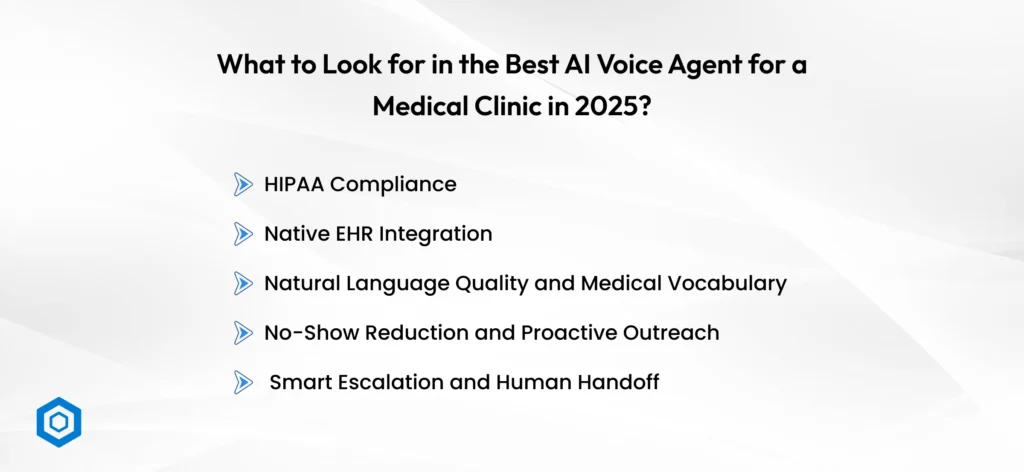
Not all AI voice agents are built for healthcare, and in this space, the wrong choice can create compliance nightmares, not just operational headaches. In the evaluation of a healthcare front desk automation platform, here are the five most important criteria to consider:
1. HIPAA Compliance
Therefore, a HIPAA-compliant AI voice agent for healthcare must handle Protected Health Information (PHI) through end-to-end encryption, signed Business Associate Agreements (BAAs), and stringent controls on data access.
In India, the DPDP Act 2023 and NMC/NABH digital health standards set forth similar requirements. If a vendor can’t instantly substantiate HIPAA compliance and/ or documented BAAs, run the other way; the liability exposure is far too great for any practice to withstand.
2. Native EHR Integration
The best AI voice agents connect directly to your EHR, whether that is Epic, Cerner, Athenahealth, eClinicalWorks, or an India-specific platform like Practo or eVitalRx.
EHR Integration Automation means the agent has access to your EHR so they can validate your patient’s identity, check their appointment history, update booking records, and flag anything overdue in care, all on a single call without your staff touching a keyboard.
As a result, platforms that cannot natively connect to your EHR or require manual data sync will create additional work, not reduce it.
3. Natural Language Quality and Medical Vocabulary
General-purpose voice AI has difficulty understanding medical terms, accents, and the non-linear ways patients describe their needs.
The best AI receptionist for clinics is trained in healthcare terminology; it knows medication names, specialty-specific terms, and common patient phrases in multiple languages.
This is especially critical for India’s linguistically diverse patient base and for USA clinics serving multilingual communities. NLP-powered conversational agents currently lead the AI voice agents in the healthcare market with a 33% revenue share, precisely because language quality is the make-or-break factor in patient trust.
4. No-Show Reduction and Proactive Outreach
One of the most tangible ROI metrics in healthcare front desk automation is the reduction in no-show rates. AI voice agents that call, text, and remind patients proactively 72 hours, 24 hours, and then two hours before the appointment routinely deliver no-show reductions of between 38% and 70%.
Reduce patient no-shows with AI voice reminders is not a mere operational win; it’s revenue protection. For a practice seeing 30 patients per day at an average visit value of $150, a 40% improvement in no-show rates can add $1,500–$2,000 in recovered revenue per week.
5. Smart Escalation and Human Handoff
But no AI system should even attempt that with every call. A strategically designed patient engagement automation platform understands exactly when to escalate when distress, urgency, or complexity are detected, and the call can seamlessly be passed to a human staff member with complete context: i.e., patient name; reason for calling; conversation recap.
This ability to handle warm handoffs is what makes truly intelligent systems pop, and the painful ones frustrating. Patients should never feel they are up against a machine to get care.
The Best AI Voice Agents for Healthcare Front Desks in 2026
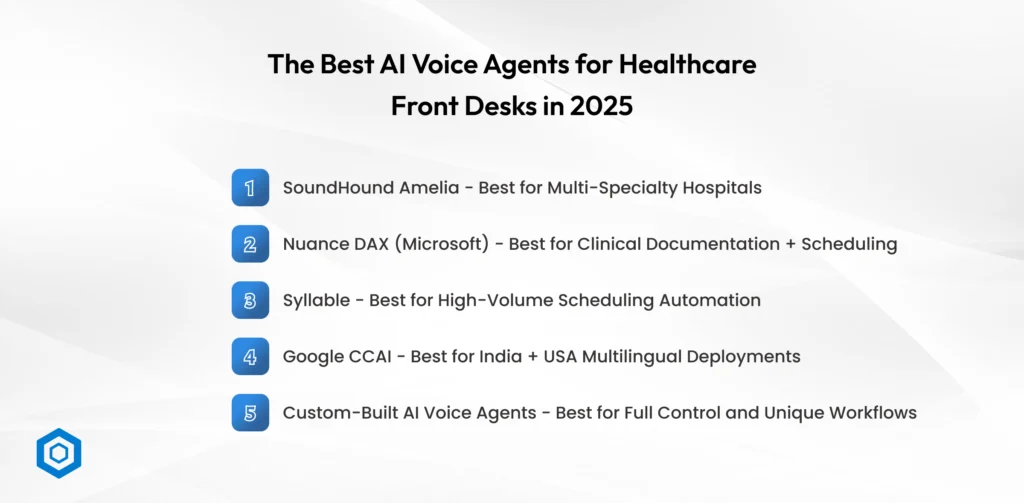
Here is an overview of the most prominent platforms currently being deployed in medical clinics and hospital networks across India and the USA:
- SoundHound Amelia – Best for Multi-Specialty Hospitals
Alli, the AI patient engagement agent powering Allina Health’s hospital network, is built on SoundHound’s Amelia platform. Alli connects directly with electronic medical records to recognize callers in real time, schedule appointments, fulfill medication refill requests, and link patients to provider searches, all within a single, natural conversation.
Amelia excels in its deep training specifically around healthcare NLP, and it does not lose the thread when under threat of a lengthy, multi-intent call. For large hospital systems in the USA handling thousands of calls daily, this is currently one of the most robust deployments available.
- Nuance DAX (Microsoft) – Best for Clinical Documentation + Scheduling
Microsoft’s Nuance Dragon Ambient eXperience (DAX) is the gold-standard universal solution for ambient clinical documentation and front-desk automation. Until March 2025, when Microsoft released Dragon Copilot, the next generation of DAX that merged the voice dictation, ambient listening, and generative AI into one clinical workflow.
For practices that also want to reduce the note-taking burden alongside front desk automation, Nuance offers an end-to-end solution deeply integrated with Epic and eClinicalWorks. It is the most enterprise-grade option available and is widely deployed across the USA health systems.
- Syllable – Best for High-Volume Scheduling Automation
Syllable is purpose-built for healthcare call deflection, intercepting the flood of routine scheduling calls before they reach your staff. Its AI agents manage appointment booking, referral management, and pre-visit instructions across multiple specialties and locations.
Syllable’s particular strength is its ability to handle complex, multi-location scheduling logic, the kind of routing that typically requires a senior front desk coordinator.
For large clinic networks in the USA looking for proven, scalable healthcare front desk automation with a fast implementation timeline, Syllable is one of the most consistently cited platforms in the market.
- Google CCAI – Best for India + USA Multilingual Deployments
Whether for a healthcare provider operating across India and the USA or serving disparate linguistic communities, Google’s Contact Center AI (CCAI) promises overhead of unmatched multilingual capability. Support for more than 30 languages, including Hindi, Tamil, Bengali, and Gujarati, CCAI is the most powerful option for all Indian healthcare networks seeking to cater to patients in their local language.
CCAI is built using Google’s Dialogflow and BERT-based NLP. Its flexible API architecture also facilitates integrations with international EHR platforms, as well as with many India-centric systems such as Practo, Medbase, and eVitalRx.
- Custom-Built AI Voice Agents – Best for Full Control and Unique Workflows
In some cases, off-the-shelf platforms just do not work. Multi-specialty clinics that have unique triage workflows, hospital networks that have custom configurations for their EHR systems, or providers who work under state-level compliance constraints each require a build-to-suit solution.
Purpose-built programmatic AI voice agent tailored to your particular patient journey and integrated with your precise EHR configuration, and trained on your terminology and workflows execution that the generic solutions cannot replicate.
Interested in seeing how a custom healthcare AI voice agent might look for your practice? Well, the AI development team at Codeflash Infotech develops tailor-made conversational forms of AI specifically for healthcare providers in India and the USA. Fully HIPAA compliant and EHR integrated from day one.
Why Choose Codeflash Infotech for AI Voice Agent Development in Healthcare?
Codeflash Infotech designs and builds custom AI voice agents for healthcare providers across India and the USA, from HIPAA-compliant conversational AI systems and EHR-integrated scheduling agents to end-to-end patient engagement automation workflows.
Unlike off-the-shelf platforms that force your clinical operations into a fixed product structure, we build around your specific EHR, call volumes, patient demographics, and compliance requirements whether that means Epic integration in the USA or Practo and eVitalRx connectivity in India.
Our solutions are engineered for long-term performance, not just for fast deployment, with lower licensing overhead, complete workflow control, and ROI timelines typically in the 3–6 month range, driven by no-show reduction and front desk cost savings alone.
If your front desk is overwhelmed, your no-show rates are cutting into revenue, or you want patients to have a better first contact experience, talk to our team today and let’s build a healthcare AI front desk solution that never misses a call.
Conclusion
The best AI voice agents for healthcare front desks are live infrastructure that leading clinics and hospitals already use to answer every call, reduce no-shows, and free their human staff for work that genuinely requires a human touch.
With the global AI voice agents in healthcare market growing at nearly 38% per year and 90% of hospitals projected to use AI agents by 2025, the question for healthcare operators in India and the USA is no longer if they should adopt this technology it is which platform fits their workflows and how quickly they can deploy it.
Whether you choose an established platform like SoundHound Amelia, Nuance DAX, or Google CCAI, or determine that a custom-built solution is the right path for your unique patient journey, the ROI case is already proven. Clinics using AI-powered healthcare front desk automation are reducing no-shows by up to 70%, recovering thousands in monthly revenue, and delivering a measurably better first contact experience to every patient without adding headcount.
FAQS
SoundHound AI Amelia, Microsoft Nuance DAX, Syllable, and Google CCAI are leading healthcare AI voice solutions in 2026. Custom AI voice agents work best for clinics needing advanced EHR integration and customized workflows.
Yes. Most healthcare AI voice agents support HIPAA compliance with BAAs, encrypted patient data, and secure access controls. Indian clinics should also verify compliance with the Digital Personal Data Protection Act, 2023.
Yes. AI voice agents can integrate with Epic, Cerner, Practo, and other healthcare systems using APIs or native EHR integrations for appointments, patient records, and workflow automation.
Healthcare AI voice agents typically cost $300–$1,500/month for clinics, while enterprise solutions can exceed $10,000/month. Custom solutions offer better long-term ROI and scalability.