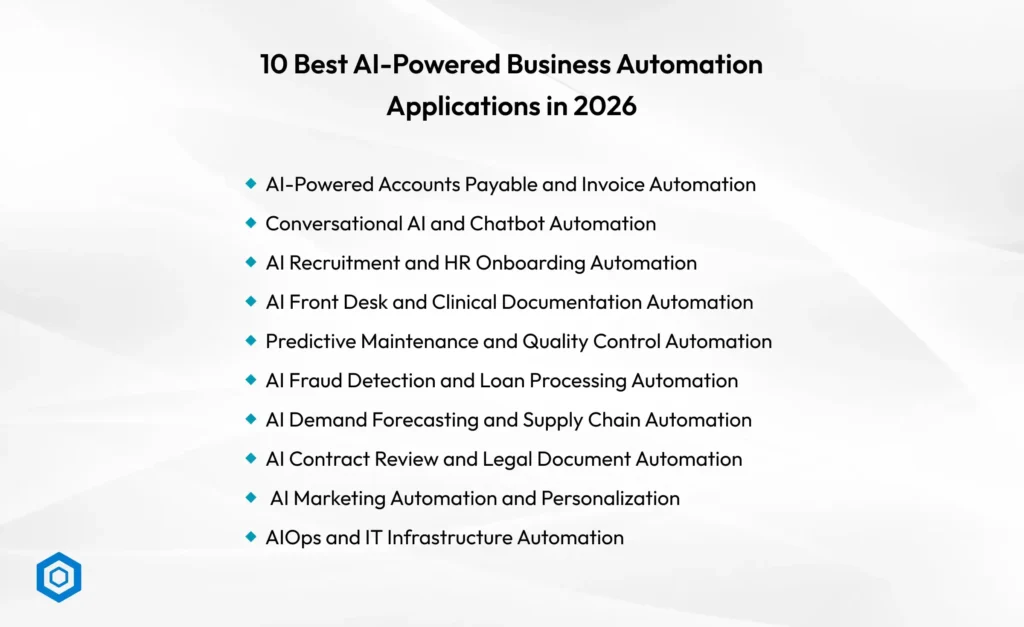
AI-Powered Accounts Payable and Invoice Automation
Finance teams waste an insane amount of time physically processing invoices, fielding data, reconciling purchase orders, routing for approvals, and following up on exceptions.
AI invoice automation solutions use OCR and NLP to extract data from invoices with over 95% accuracy, automatically match invoices to POs across ERP systems, identify inconsistencies, and route them for approval in accordance with corporate principles.
This way, up to 80 percent of transactional finance work can be automated. From specific off-the-shelf solutions such as UiPath and SAP Intelligent RPA to customised IPA stacks, enterprises are actively deploying these platforms in India and the USA to reduce invoice processing time from days to hours and achieve 60–80% cost-per-invoice reduction.
Conversational AI and Chatbot Automation
Customer service is the most common use case for AI automation across all industries. Now, AI-driven chatbots and voice agents handle Tier 1 and Tier 2 support questions, order status, account management, troubleshooting, and FAQs across web, mobile, and voice channels around the clock.
52% of telecom companies use an AI chatbot, and 4 out of 5 consumers expect a positive interaction with the bot to improve their overall experience.
For Indian enterprises managing multilingual customer bases and USA businesses tackling high-volume support, conversational AI reduces average handle time by up to 40% while delivering satisfaction scores that match those of human agents for rote exchanges.
AI Recruitment and HR Onboarding Automation
HR teams spend a lot of productive hours on resume screening, interview scheduling, background check coordination, and onboarding paperwork.
AI recruitment automation uses natural language processing to screen through hundreds of applications for job criteria in seconds, then rank candidates by fit score and schedule interviews automatically via calendar integration.
Post-hire, digital transformation software automates the entire onboarding journey from document collection and IT provisioning requests to policy acknowledgement and training assignment, reducing time-to-productivity for new hires by up to 50%.
Companies like Unilever and Infosys have publicly reported major efficiency gains from AI-driven recruitment, cutting screening time from weeks to hours.
AI Front Desk and Clinical Documentation Automation
Healthcare is one of the most document-heavy industries on the planet, and AI is finally making a meaningful dent in it. AI voice agents independently manage appointment scheduling, patient intake, prescription refill routing, and post-visit follow-ups.
On the clinical side, ambient AI documentation tools such as Microsoft’s Nuance Dragon Copilot listen in on physician-patient conversations and automatically generate structured clinical notes, reducing documentation time by up to 45 minutes per provider per day.
38% of healthcare providers now rely on AI-assisted diagnostics and clinical decision support. For hospitals and clinics in India and the USA, this combination of front desk automation and clinical AI is simultaneously transforming both the patient experience and physician burnout rates.
Predictive Maintenance and Quality Control Automation
Robotic process automation originated in manufacturing, and AI has elevated it. Predictive maintenance systems leverage IoT sensor data and ML models to forecast equipment failures before they happen, decreasing unplanned downtime by 30–50% and lowering maintenance costs by 20–25%.
Computer vision-based quality control systems inspect products on assembly lines at speeds and accuracy levels no human inspector can match, detecting defects, dimensional deviations, and surface anomalies in milliseconds.
The automotive sector has seen a 48% rise in machine learning adoption for exactly these applications. For Indian manufacturers in automotive, pharma, and textiles and USA factories navigating labour shortages, AI-powered quality and maintenance automation is fast becoming a competitive necessity.
AI Fraud Detection and Loan Processing Automation
No industry has, arguably, seen deeper AI automation penetration than financial services. AI fraud detection systems score each transaction in real time and cut fraud losses by as much as 40%, while lowering false positives that annoy legitimate customers.
AI-based loan processing automation manages the entire origination pipeline, including KYC verification, eligibility assessment, credit risk scoring, and disbursement, shaving approval times down from weeks to hours.
60% of loan decisions on major digital lending platforms are now driven by predictive analytics models. If you want to understand how AI-powered fintech automation applies to your lending or payments business specifically, Codeflash Infotech builds custom fraud detection and loan automation systems for lenders across India and the USA.
AI Demand Forecasting and Supply Chain Automation
Global businesses lose trillions of dollars each year due to supply chain disruptions, and demand forecasting using AI is one of the most time-tested tools to reduce that exposure.
ML models process historical sales data, seasonality, economic indicators, and supplier lead times to produce demand forecasts with an accuracy rate of 85%–92%, compared with 60%–70% for traditional statistical approaches.
Smart inventory replenishment systems automatically generate purchase orders when stock levels dip below dynamic thresholds, and AI decides which routes and carriers to use, making instant decisions that get your product where it needs to go.
This is a layer that Walmart, Amazon, and Flipkart have all invested significantly in, and via SaaS platforms, mid-market enterprises are beginning to access similar capabilities in India and the USA.
AI Contract Review and Legal Document Automation
Legal teams at enterprises spend tens of thousands of hours each year reviewing contracts for risk clauses, missing provisions, and compliance requirements, now all being handled by A.I. in minutes.
AI contract review platforms apply natural language processing to flag non-standard clauses, summarize obligations, and compare the terms of an agreement against what is seen elsewhere in the market, with accuracy akin to that of a junior associate costing one-tenth.
Contract lifecycle management automation handles routing, approvals, e-signature collection, obligation tracking, and renewal alerts automatically. For compliance-heavy industries in India (SEBI, RBI regulations) and the USA (SEC, FTC, state-level requirements), AI legal automation is rapidly becoming an essential risk management tool.
AI Marketing Automation and Personalisation
75.7% of digital marketers now use AI tools in their daily work, and the reason is simple: AI makes personalisation scalable in a way humans simply cannot.
AI marketing automation platforms perform deep-dive analyses of customer behaviour, purchase history, and engagement signals to trigger hyper-personal email campaigns, SMS sequences, and ad retargeting at the individual customer level for millions of contacts concurrently.
For example, predictive lead scoring models allow sales teams to prioritise the prospects most likely to convert, decreasing time spent on useless outreach and increasing conversion rates.
HubSpot, Marketo, and Salesforce Einstein have all built AI automation deeply into their platforms, and for growing businesses in India and the USA, these capabilities are now accessible without enterprise-scale budgets.
AIOps and IT Infrastructure Automation
IT operations teams are overwhelmed by alert noise from monitoring dashboards logging hundreds of events an hour, the vast majority of which are duplicates, false positives, or low-priority.
AIOps platforms apply ML to correlate alerts and identify root causes, and auto-remediate common incidents, cutting mean time to resolution (MTTR) by up to 60% while dramatically reducing alert fatigue.
Automated IT operations also handle routine tasks such as patch management, backup validation, user provisioning, and infrastructure scaling, enabling DevOps and IT teams to focus on architecture and innovation rather than firefighting.