Software Development Outsourcing Services: Benefits, Models, Best Practices & Complete Guide
Software Development Outsourcing: The Complete Strategic Guide
20 FEBRUARY.
Introduction
In today’s fast-evolving digital landscape, software has become the backbone of almost every business — from customer engagement to internal operations. Yet building a capable in-house development team requires enormous investment in hiring, infrastructure, training, and ongoing management.
This is why thousands of organizations are turning to software development outsourcing services. Outsourcing lets businesses access skilled professionals, accelerate development timelines, and control costs — without compromising quality. This guide walks you through everything you need to make a confident outsourcing decision in 2026.
At Codeflash Infotech, we help companies of all sizes successfully outsource software development through structured processes, expert teams, and scalable delivery models.
Quick Take: Outsourcing is not just about saving money — it is a strategic tool for accessing innovation, reducing time-to-market, and building scalable digital products. Learn more about our custom software development services
What Is Software Development Outsourcing?
Software development outsourcing is the practice of partnering with an external company or remote team to handle software-related tasks instead of managing them in-house. Outsourced work can include anything from full product development and feature enhancements to application modernization, quality assurance, and post-launch maintenance.
A reliable outsourcing company acts as a seamless extension of your internal team. According toGartner’s IT outsourcing research, organizations that partner strategically with outsourcing vendors consistently outperform those relying solely on in-house resources for innovation velocity.
Outsourcing is ideal for businesses that want to:
✓Launch products faster without waiting months to hire
✓Reduce operational and HR overhead
✓Access advanced technical expertise on demand
✓Scale teams up or down flexibly as project needs evolve
A reliable software development outsourcing company acts as an extension of your internal team, ensuring seamless collaboration and consistent results.
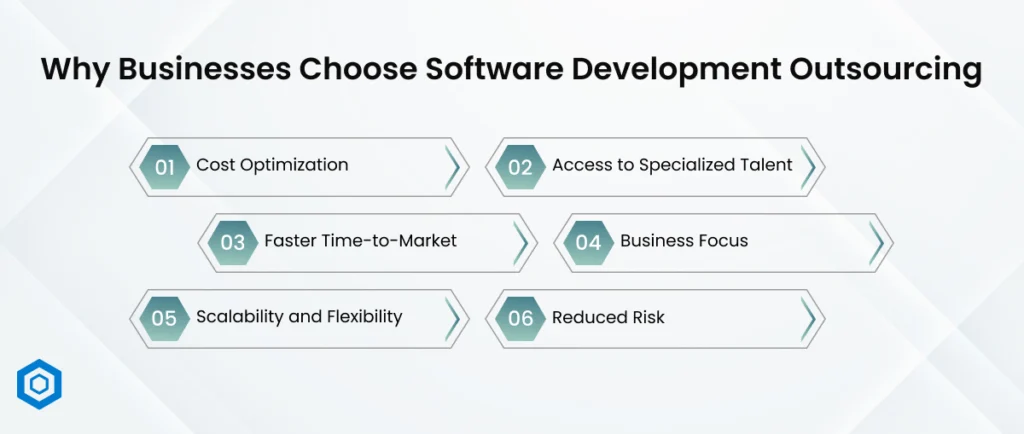
Why Businesses Choose Software Development Outsourcing
Cost Optimization
Eliminate salaries, benefits, office space, and training costs. Outsourcing offers predictable pricing models that typically save 40-60% compared to in-house development.
Access to Specialized Talent
Tap into experts in AI, cloud computing, blockchain, mobile development, and DevOps — technologies that are hard to hire for locally.
Faster Time-to-Market
Outsourcing partners follow proven Agile methodologies and ready-to-use frameworks that significantly reduce development cycles.
Business Focus
Your internal team stays focused on strategy, marketing, and customer experience while the outsourcing team handles technical execution.
Scalability & Flexibility
Increase or decrease team size based on project needs — no long-term hiring commitments required.
Reduced Risk
Experienced partners follow structured project management, quality standards, and documentation practices — dramatically reducing the risk of project failure.
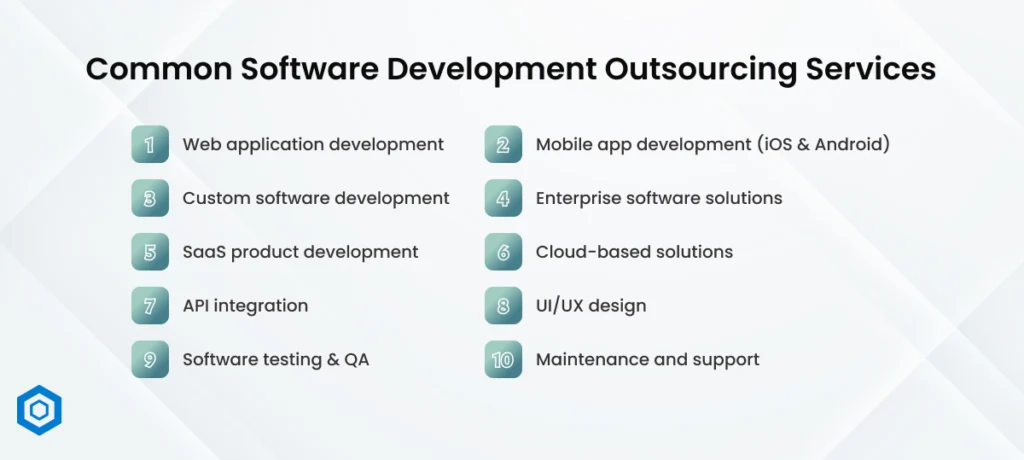
Common Software Development Outsourcing Services
In today’s fast-paced digital landscape, businesses need scalable, secure, and high-performing software solutions to stay competitive. Partnering with a reliable outsourcing company like Codeflash Infotech enables organizations to access top-tier technical expertise, reduce development costs, and accelerate time-to-market.
Below is a detailed overview of the most common software development outsourcing services and how they help businesses grow.
1. Web Application Development
Outsourcing partners build responsive, secure, and scalable web applications tailored to business needs. From e-commerce platforms to enterprise dashboards, modern web apps improve user engagement and operational efficiency.
2. Mobile App Development (iOS & Android)
Professional teams develop high-performance native and cross-platform mobile apps. These apps enhance customer engagement, brand visibility, and business growth across devices.
3. Custom Software Development
Custom software solutions are designed to match unique business processes and goals. They help automate operations, improve productivity, and provide a competitive advantage.
4. Enterprise Software Solutions
Enterprise systems integrate multiple departments into a unified digital ecosystem. They streamline workflows, enhance collaboration, and support data-driven decision-making.
5. SaaS Product Development
Outsourcing companies help build scalable, cloud-based SaaS products with secure multi-tenant architecture. This enables businesses to launch faster and generate recurring revenue.
6. Cloud-Based Solutions
Cloud services include application migration, infrastructure setup, and DevOps implementation. These solutions improve scalability, flexibility, and cost efficiency.
7. API Integration
API integration ensures seamless communication between different software platforms. It enhances automation, data synchronization, and system performance.
8. UI/UX Design
Professional UI/UX design focuses on intuitive interfaces and smooth user journeys. A well-designed product increases engagement, retention, and customer satisfaction.
9. Software Testing & QA
Quality assurance ensures that applications are secure, stable, and bug-free before deployment. Testing improves performance and reduces long-term maintenance risks.
10. Maintenance and Support
Post-launch support includes updates, security monitoring, and performance optimization. Ongoing maintenance ensures long-term reliability and system efficiency.
These services help businesses build scalable, secure, and high-performing software systems.
Software Development Outsourcing Models
Choosing the right outsourcing model is crucial for project success.
1. Dedicated Team Model
A team of developers works exclusively on your project.
Best for:
Long-term projects
Continuous product development
Startups and SaaS platforms
2. Project-Based Model
The outsourcing partner manages the complete project lifecycle.
Best for:
Fixed-scope projects
MVP development
Short-term initiatives
3. Staff Augmentation Model
External developers join your internal team.
Best for:
Skill gaps
Short-term resource needs
Technology-specific projects
Offshore, Nearshore & Onshore Outsourcing
Model
Location
Cost
Time Zone
Best For
Offshore
Distant countries (India, Eastern Europe)
Lowest
Minimal — async needed
Max cost savings on long-term projects
Nearshore
Nearby regions (Latin America for US)
Mid-range
Significant overlap
Balanced cost + communication
Onshore
Same country
Highest
Full overlap
Regulated industries, easy collaboration
India remains one of the most popular offshore destinations. According to NASSCOM, India’s IT-BPM sector employs over 5 million professionals, making it a premier hub for software development outsourcing.
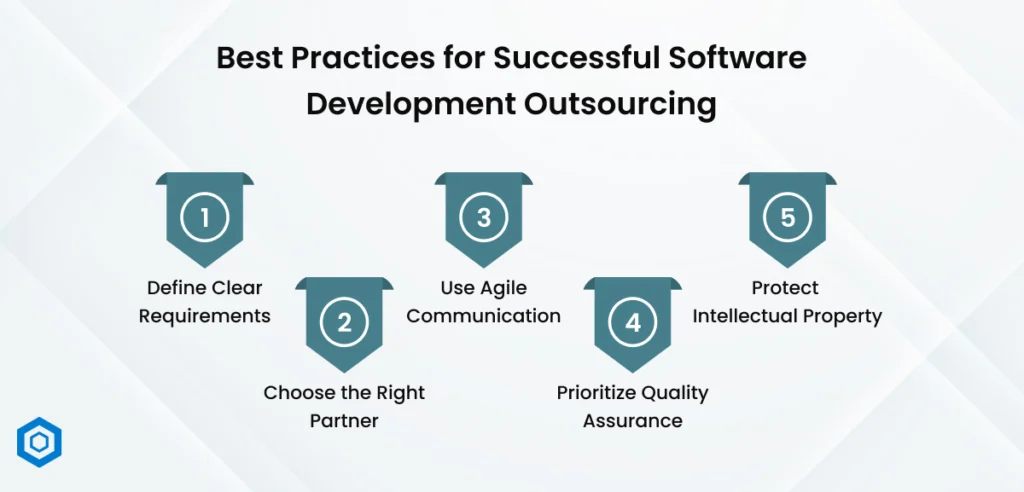
Best Practices for Successful Software Development Outsourcing
1. Define Clear Requirements Upfront
Document your objectives, core features, timelines, and technical expectations in detail. Ambiguity is the #1 cause of outsourcing failures. Consider using a Software Requirements Specification (SRS) template to structure your documentation.
2. Choose the Right Partner
Review the company’s experience, portfolio, and client testimonials on platforms like Clutch.co. Always conduct a technical discovery session before signing any contract.
3. Prioritize Agile Communication
Schedule regular sprint reviews and milestone demos. Use tools like Jira, Slack, and Zoom to keep everyone aligned across time zones.
4. Insist on Quality Assurance at Every Stage
Ensure code reviews, automated testing, performance benchmarking, and security audits are integrated into the development pipeline. Learn about our QA and software testing services.
How Codeflash Infotech Supports Your Outsourcing Goals
AtCodeflash Infotech, we provide reliable and scalable software development outsourcing services tailored to your needs. We work as your technology partner — not just a service provider.
✓ Custom software development across all major stacks
✓ Web & mobile app development (React, Flutter, Node.js, Python, and more)
✓ SaaS platform development with cloud-native architecture
✓ Enterprise application development (ERP, CRM, HRMS)
✓ Agile delivery with DevOps and CI/CD integration
✓ UI/UX design and comprehensive QA testing
✓ Transparent workflows with milestone-based reporting
Software development outsourcing is no longer just a cost-saving tactic—it is a strategic approach to innovation, growth, and scalability. With the right partner, businesses can build powerful digital products without the burden of managing large in-house teams.
At Codeflash Infotech, we serve as your complete Software Development Outsourcing Guide, helping you plan, execute, and scale software solutions with confidence.
Yes. With proper NDAs, IP assignment agreements, and data protection policies aligned with frameworks like GDPR or HIPAA, outsourcing is highly secure. Always vet a partner’s security certifications before engagement.
Costs depend on project scope, team size, and technology stack. Offshore outsourcing is typically 40-60% cheaper than maintaining a fully in-house team.
Use project management tools like Jira or Trello, establish regular sprint reviews, and set milestone-based reporting. A good outsourcing partner provides a dedicated Project Manager to handle day-to-day coordination.